


Plants recognize siblings, and UD researchers have discovered how
Related images
(click to enlarge)
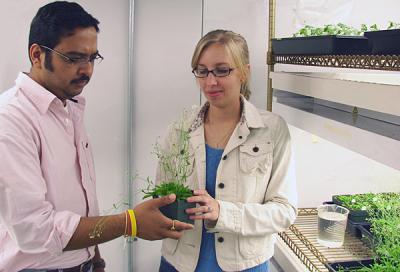
Plants may not have eyes and ears, but they can recognize their siblings, and researchers at the University of Delaware have discovered how. The ID system lies in the roots and the chemical cues they secrete.
The finding not only sheds light on the intriguing sensing system in plants, but also may have implications for agriculture and even home gardening.
The study, which is reported in the scientific journal Communicative & Integrative Biology, was led by Harsh Bais, assistant professor of plant and soil sciences at the University of Delaware.
Canadian researchers published in 2007 that sea rocket, a common seashore plant, can recognize its siblings -- plants grown from seeds from the same mother.
Susan Dudley, an evolutionary plant ecologist at McMaster University in Hamilton, Ontario, and her colleagues observed that when siblings are grown next to each other in the soil, they "play nice" and don't send out more roots to compete with one another.
However, the moment one of the plants is thrown in with strangers, it begins competing with them by rapidly growing more roots to take up the water and mineral nutrients in the soil.
Bais, who has conducted a variety of research on plant signaling systems, read Dudley's study and wanted to find the mechanism behind the sibling recognition.
"Plants have no visible sensory markers, and they can't run away from where they are planted," Bais says. "It then becomes a search for more complex patterns of recognition."
Working in his laboratory at the Delaware Biotechnology Institute, a major center for life sciences research at UD, Bais and doctoral student Meredith Biedrzycki set up a study with wild populations of Arabidopsis thaliana.
They utilized wild populations to avoid issues with this common laboratory-bred species, which "always has cousins floating around in the lab," Bais says.
In a series of experiments, young seedlings were exposed to liquid media containing the root secretions or "exudates" from siblings, from strangers (non-siblings), or only their own exudates.
The length of the longest lateral root and of the hypocotyl, the first leaf-like structure that forms on the plant, were measured.
Additionally, in one experiment, the root exudates were inhibited by sodium orthovanadate, which specifically blocks root secretions without imparting adverse growth effects on roots.
The exposure of plants to the root exudates of strangers induced greater lateral root formation than exposure of plants to sibling exudates. Stranger recognition was abolished upon treatment with the secretion inhibitor.
Biedrzycki did the painstaking laboratory research, rotating more than 3,000 plants involved in the study every day for seven consecutive days and documenting the root patterns.
"The research was very painstaking because Arabidopsis roots are nearly translucent when they are young and were also tangled when I removed them from plates, so measuring the roots took a great amount of patience," Biedrzycki notes.
"This manuscript is very important for my research since the focus of my thesis project is understanding the biochemical mechanism behind root secretions," she says. "This research has allowed me to probe the natural mechanism of kin recognition and root secretion."
The study was replicated by Dudley's lab in Canada, with similar results.
Strangers planted next to each other are often shorter, Bais notes, because so much of their energy is directed at root growth.
Because siblings aren't competing against each other, their roots are often much shallower.
Bais says he and his colleagues also have noticed that as sibling plants grow next to each other, their leaves often will touch and intertwine compared to strangers that grow rigidly upright and avoid touching.
The study leaves a lot of unanswered questions that Bais hopes to explore further. How might sibling plants grown in large "monocultures," such as corn or other major crop plants, be affected? Are they more susceptible to pathogens? And how do they survive without competing?
"It's possible that when kin are grown together, they may balance their nutrient uptake and not be greedy," Bais speculates.
The research also may have implications for the home gardener.
"Often we'll put plants in the ground next to each other and when they don't do well, we blame the local garden center where we bought them or we attribute their failure to a pathogen," Bais says. "But maybe there's more to it than that."
Source: University of Delaware
Other sources
- Plants Know Their Siblingsfrom Live ScienceThu, 15 Oct 2009, 14:42:14 UTC
- Plants Recognize Siblings: ID System In Rootsfrom Science DailyThu, 15 Oct 2009, 2:28:43 UTC
- Plants recognize siblings, and UD researchers have discovered howfrom Science BlogWed, 14 Oct 2009, 18:56:57 UTC
- Plants recognize siblings, researchers discover howfrom PhysorgWed, 14 Oct 2009, 18:35:12 UTC