


How stem cells make skin
Related images
(click to enlarge)
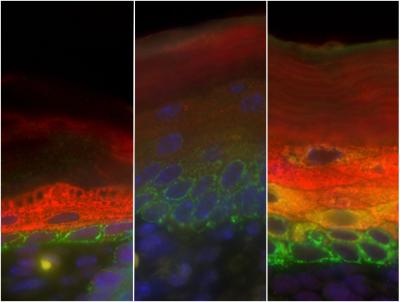
Stem cells have a unique ability: when they divide, they can either give rise to more stem cells, or to a variety of specialised cell types. In both mice and humans, a layer of cells at the base of the skin contains stem cells that can develop into the specialised cells in the layers above. Scientists at the European Molecular Biology Laboratory (EMBL) in Monterotondo, in collaboration with colleagues at the Centro de Investigaciones Energéticas, Medioambientales y Tecnologicas (CIEMAT) in Madrid, have discovered two proteins that control when and how these stem cells switch to being skin cells. The findings, published online today in Nature Cell Biology, shed light on the basic mechanisms involved not only in formation of skin, but also on skin cancer and other epithelial cancers. At some point in their lives, the stem cells at the base of the skin stop proliferating and start differentiating into the cells that form the skin itself. To do so, they must turn off the 'stem cell programme' in their genes and turn on the 'skin cell programme'. Researchers suspected that a family of proteins called C/EBPs might be involved in this process, as they were known to regulate it in other types of stem cell, but had so far failed to identify which C/EBP protein controlled the switch in skin. Claus Nerlov and his group at EMBL Monterotondo discovered it was not one protein, but two: C/EBPα and C/EBPβ.
The EMBL researchers used genetic engineering techniques to delete the genes that encode C/EBPα and β specifically in the skin of mouse embryos, and found that without these proteins the skin of the mice did not form properly.
"Mice with neither C/EBPα nor β had taut and shiny skin that couldn't keep the water inside their bodies", Nerlov explains, "they lacked many of the proteins that make skin mechanically strong and water tight, and they died of de-hydration shortly after birth".
However, a single working copy of either the gene for C/EBPα or the gene for C/EBPβ was enough to ensure that skin developed properly. This means that the two proteins normally do the same job in the skin's stem cells - an unexpected redundancy, which may have arisen because there are so many stem cells in skin that a tight control on proliferation is needed to avoid problems like cancer. Or it may simply be a by-product of the fact that these two proteins have different functions in other situations, such as wound healing or repair of sunlight-induced skin damage.
One of the hallmarks of epithelial cancers - which include skin, breast, and oral cancers - is that they have genes turned on which would normally only be expressed in embryonic stem cells, and which may help cancer cells divide indefinitely. Such genes become re-expressed in the skin in the absence of C/EBPs. So, by understanding how C/EBPα and β turn off such 'stem cell' programmes, researchers hope to come a step closer to finding ways to fight such cancers.
When Nerlov and colleagues looked at how C/EBPα and -β work in the skin, they found that these proteins also regulate a number of other molecules that control skin development. Several important pathways known to control skin and hair formation were improperly activated in the mice lacking C/EBPα and -β.
"This is a very important discovery", says Nerlov. "It opens up a lot of new areas, because we can see how these proteins control virtually every other molecule known to regulate skin cell differentiation. It seems to be a key piece in the puzzle of how our skin is formed and maintained throughout life."
Source: European Molecular Biology Laboratory
Other sources
- How stem cells make skinfrom Biology News NetTue, 15 Sep 2009, 0:28:04 UTC
- How stem cells make skinfrom Science BlogSun, 13 Sep 2009, 23:35:20 UTC
- How Stem Cells Make Skinfrom Science DailySun, 13 Sep 2009, 22:35:05 UTC
- How stem cells make skinfrom PhysorgSun, 13 Sep 2009, 19:14:07 UTC
- How stem cells make skinfrom Science BlogSun, 13 Sep 2009, 17:35:35 UTC