


Global warming causes outbreak of rare algae associated with corals, study finds
Related images
(click to enlarge)

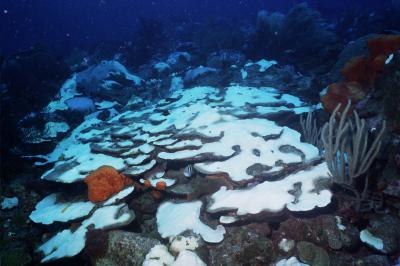
A rare opportunity has allowed a team of biologists to evaluate corals and the essential, photosynthetic algae that live inside their cells before, during, and after a period in 2005 when global warming caused sea-surface temperatures in the Caribbean Ocean to rise. The team, led by Penn State Assistant Professor of Biology Todd LaJeunesse, found that a rare species of algae that is tolerant of stressful environmental conditions proliferated in corals as the more-sensitive algae were being expelled from corals. The results will be published in the online version of the journal Proceedings of the Royal Society B on 9 September 2009. "Symbiodinium trenchi is normally a rare species of micro-alga in the Caribbean," said LaJeunesse. "Because the species is apparently tolerant of high or fluctuating temperatures, it was able to take advantage of the warming event and become more prolific. In this way, Symbiodinium trenchi appears to have saved certain colonies of coral from the damaging effects of unusually warm water. As ocean temperatures continue to rise as a result of global warming, we can expect this species to become more common and persistent. However, since it is not normally associated with corals in the Caribbean, we don't know if its increased presence will benefit or harm corals in the long term."
According to LaJeunesse, certain species of algae have evolved over millions of years to live in symbiotic relationships with certain species of corals. The photosynthetic algae provide the corals with nutrients and energy, while the corals provide the algae with nutrients and a place to live. "There is a fine balance between giving and taking in these symbiotic relationships," said LaJeunesse. "If Symbiodinium trenchi takes from the corals more than it gives back, then over time we will see the health of the corals diminish."
In 2005, sea surface temperatures in the Caribbean Ocean rose by up to two degrees Celsius above normal for a period of three to four months, high enough and long enough to severely stress the natural symbioses. This process of damaged or dying algae being expelled from the cells of corals is known as bleaching because it leaves behind bone-white coral skeletons that soon will die without their symbiotic partners.
During the summer of 2005, prior to the bleaching event, LaJeunesse and his colleagues collected samples of coral and algae from two locations near Barbados in the Caribbean. "We collected the samples as part of an effort to document the diversity of Symbiodinium species around the world and to study how relationships between certain species of corals and algae differ across geographic space," he said.
By late November, water temperatures had peaked and many corals were bleached. "Finding out about the bleaching event was bittersweet," said LaJeunesse. "It was upsetting to see how severe the impact was to the coral communities, but I also knew it would be a good opportunity to learn more about what happens to corals and their algal partners during times of acute stress. In fact, I knew that this would be one of the first times that anyone had had the opportunity to conduct a community-wide study of corals and algae before, during, and after a bleaching event."
The team collected samples of coral and algae during the bleaching event and again two years after ocean temperatures returned to normal. In the laboratory, they sequenced the organisms' DNA to identify the species.
"During the bleaching event, we found that Symbiodinium trenchi, which we rarely find in the Caribbean, had increased in frequency by 50 percent, or more, within coral species that are most sensitive to warm water. We also saw this species in corals where it had never been before. Two years later, we found that the abundance and occurrence of Symbiodinium trenchi had diminished significantly," said LaJeunesse. Today, the symbioses have mostly recovered to their normal state, and the corals have been repopulated by their typical algal symbionts," he said.
Although Symbiodinium trenchi appears to have saved some Barbadian corals from possibly dying in 2005, LaJeunesse is concerned that the species might not be good for the corals in the long term in the event that warming trends continue and Symbiodinium trenchi becomes more common. "Because Symbiodinium trenchi does not appear to have successfully co-evolved with Caribbean coral species, it may not provide the corals with adequate nutrition," he said.
In the future, LaJeunesse plans to further investigate the relationships among Symbiodinium trenchi and Caribbean coral species. "We're interested in looking at how Symbiodinium trenchi behaves in other regions of the world where it is naturally common. We also want to look more closely at the give-and-take relationship between Symbiodinium trenchi and corals in the Caribbean.
Source: Penn State
Other sources
- Global Warming Causes Outbreak Of Rare Algae Associated With Corals, Study Findsfrom Science DailySat, 12 Sep 2009, 12:07:14 UTC
- Algae may shield coral from global warmingfrom UPIThu, 10 Sep 2009, 18:14:10 UTC
- Global warming causes outbreak of rare algae associated with corals, study findsfrom PhysorgThu, 10 Sep 2009, 0:35:23 UTC
- One coral alga explodes with temperature increasefrom Sciencenews.orgWed, 9 Sep 2009, 18:14:03 UTC