


Princeton team learns why some drugs pack such a punch
Related images
(click to enlarge)
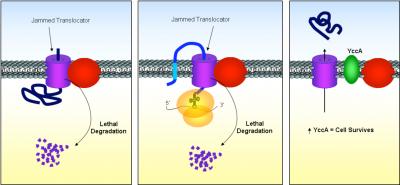
By studying the intricate mechanisms at work in protein production, a Princeton-led team has discovered why certain kinds of antibiotics are so effective. In doing so, they also have discovered how one protein protects against cell death, shedding light on a natural cancer-fighting process. In a study appearing in the Aug. 7 edition of the journal Science, Thomas Silhavy, Princeton's Warner-Lambert Parke-Davis Professor of Molecular Biology, and Johna van Stelten, a graduate student, working with two Swiss researchers have uncovered how some antibiotics in common use for 50 years -- tetracycline and chloramphenicol -- can be so lethal against certain strains of bacteria.
Simply put, these drugs plug things up.
Silhavy and van Stelten had been studying the mechanism by which proteins -- from antibodies to hormones -- are produced in bacteria's cytoplasm, the gooey substance that makes up the cell's interior, and then transported where they are needed. The spaghetti-like proteins exit the bacteria's cytoplasm through microscopic tubes known as translocators.
Sometimes, proteins fold up accidentally and jam the translocator. "Proteins go through the translocator, like a piece of spaghetti through a hole," Silhavy said. "But if you can imagine if you were to tie knots in the spaghetti, it wouldn't be able to get through; it gets stuck."
What happens then is ugly, according to Silhavy and van Stelten, who were the first ever to observe the event.
The bacterial cell actually attacks the jammed translocator, decimating it.
The researchers wondered what might happen in a more complex scenario, such as if antibiotics were introduced into the cell cytoplasm to purposely thwart bacteria.
The scientists found that the antibiotics tetracycline and chloramphenicol cause the ribosomes, a cell's protein-producing machines, to stop midway through the process of making proteins, leaving partially constructed proteins stuck to the ribosome, jamming the translocator in the bacteria.
"This is very similar to plugging the translocator with a folded protein and, sure enough, this also causes translocator destruction," Silhavy said. "It's like putting an anchor on the spaghetti instead of a knot. They are stuck and dead forever."
Researchers had been confused as to why these antibiotics seemed to be so adept at killing some kinds of bacteria more quickly than others. These experiments provide an explanation. Translocators are essential for life and, if some bacteria have fewer translocators from the start, then they are more vulnerable to such an attack.
"While it has been known for many years that these antibiotics work by inhibiting bacterial protein synthesis, it was not clear why some bacteria in a population appeared more susceptible than others," van Stelten said. "Our work has identified a new reason why these antibiotics are lethal to bacteria that may help explain these earlier findings."
The researchers made their discovery not because of a new piece of equipment or a new technique. "Like the vast majority of advancements in science and medicine, we happened upon this remarkable answer through basic research," van Stelten said.
The finding could have important implications for medicine.
"If we are to have any hope of outpacing the antibiotic resistance obtained by bacteria, it is paramount that we fully understand the mechanism of action of the antibiotics we currently use," van Stelten said. "Unfortunately, this is often very difficult as evidenced by the fact that, 50 years on, we are still learning new things about them."
Their work also produced another important result. When the translocators in bacteria became jammed by errant proteins, the researchers observed that the translocators emitted a molecular signal -- a stress response -- that called in a destructive enzyme known as the FtsH protease. Under normal circumstances, the FtsH protease chops up the jammed translocators, contributing to cell death.
The scientists found, however, that when they increased the amount of YccA, a protein that is present in the bacterial cell, YccA proteins protected the translocators from the FtsH attackers. YccA, it turns out, is very similar to a human protein known as Bax Inhibitor-1 (BI-1) that is of great interest to cancer researchers because cancer proliferates when it malfunctions.
"We have determined how YccA works in preventing stress-induced death in bacteria," van Stelten said. "We hope this new information will shed light on the mechanism of BI-1 in humans."
Source: Princeton University
Other sources
- Why Some Antibiotic Drugs Pack Such A Punchfrom Science DailyFri, 21 Aug 2009, 3:14:17 UTC
- Scientists learn why some drugs pack such a punchfrom PhysorgThu, 20 Aug 2009, 16:28:44 UTC