


Beep, beep, oops, what was I doing?
Related images
(click to enlarge)
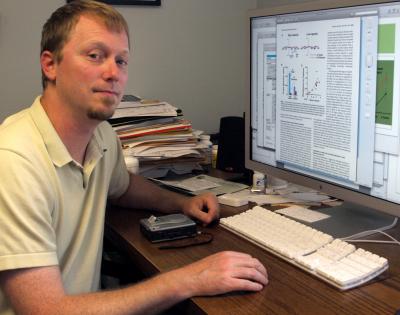
"That blasted siren. I can't focus." That reaction to undesired distraction may signal a person's low working-memory capacity, according to a new study. Based on a study of 84 students divided into four separate experiments, University of Oregon researchers found that students with high memory storage capacity were clearly better able to ignore distractions and stay focused on their assigned tasks.
Principal investigator Edward K. Vogel, a UO professor of psychology, compares working memory to a computer's random-access memory (RAM) rather than the hard drive's size -- the higher the RAM, the better processing abilities. With more RAM, he said, students were better able to ignore distractions. This notion surfaced in a 2005 paper in Nature by Vogel and colleagues in the Oregon Visual Working Memory & Attention Lab.
In experiments with some variations in approaches -- detailed in the July 8 issue of the Journal of Neuroscience -- students' brain activity was monitored using electroencephalography (EEG) while they studied images on a computer screen, recognizing a shape with a missing component, and then identifying the object after it moved simply to another location or amid distractions. Using a "task irrelevant probe" -- a 50 millisecond-long flash of light -- Vogel and Keisuke Fukuda, a doctoral student of Vogel's and lead author, were able to determine where exactly a subject's attention was focused.
All of the subjects were able to quickly and accurately identify the targets when the objects moved around the screen, but as distracting components were added some maintained accuracy while others diverted their attention and slipped in performing the assigned tasks. (Vogel describes his research in a video at: http://www.youtube.com/watch?v=cmToeopS9bY.)
Vogel is quick to say that the findings don't necessarily signify problems for an easily distracted person, although people who hold their focus more intensely tend to have higher fluid intelligence; they score higher on achievement tests, do better in math and learn second languages easier than peers who are captured by interruptions. Vogel currently is working with other UO researchers to explore if the easily distracted indeed have a positive side, such as in artistic creativity and imagination.
The new research, funded by the National Science Foundation, zeroed in on the brain's prefrontal cortex -- a region linked to executive function and under scrutiny for its association with many neurological disorders -- and the intraparietal sulcus (IPS), which is involved in perceptual-motor coordination, including eye movements.
The IPS, Vogel said, acts as a pointer system that seeks out goal-related cues, and it possibly is the gateway for memory circuitry in the brain.
"Our attention is the continual interplay between what our goals are and what the environment is trying to dictate to us," Vogel said. "Often, to be able to complete complex and important goal-directed behavior, we need to be able to ignore salient but irrelevant things, such as advertisements flashing around an article you are trying to read on a computer screen. We found that some people are really good at overriding attention capture, and other people have a difficult time unhooking from it and are really susceptible to irrelevant stimuli."
Vogel theorizes that people who are good at staying on focus have a good gatekeeper, much like a bouncer or ticket-taker hired to allow only approved people into a nightclub or concert. Understanding how to improve the gatekeeper component, he said, could lead to therapies that help easily distracted people better process what information is allowed in initially, rather than attempting to teach people how to force more information into their memory banks.
Source: University of Oregon
Other sources
- People With Lots Of Working Memory Are Not Easily Distractedfrom Science DailySat, 8 Aug 2009, 2:21:23 UTC
- Beep, beep, oops, what was I doing? (w/ Video)from PhysorgThu, 6 Aug 2009, 20:21:21 UTC