


Schizophrenia and bipolar disorder share genetic roots
Related images
(click to enlarge)
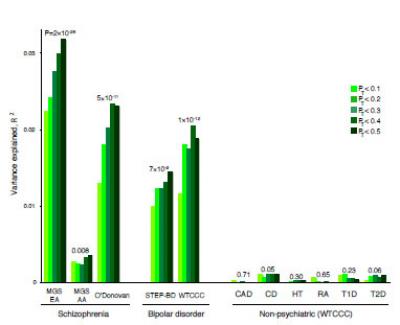
A trio of genome-wide studies – collectively the largest to date – has pinpointed a vast array of genetic variation that cumulatively may account for at least one third of the genetic risk for schizophrenia. One of the studies traced schizophrenia and bipolar disorder, in part, to the same chromosomal neighborhoods. "These new results recommend a fresh look at our diagnostic categories," said Thomas R. Insel, M.D., director of the National Institute of Mental Health (NIMH), part of the National Institutes of Health. "If some of the same genetic risks underlie schizophrenia and bipolar disorder, perhaps these disorders originate from some common vulnerability in brain development."
Three schizophrenia genetics research consortia, each funded in part by NIMH, report separately on their genome-wide association studies online July 1, 2009, in the journal Nature. However, the SGENE, International Schizophrenia (ISC) and Molecular Genetics of Schizophrenia (MGS) consortia shared their results – making possible meta-analyses of a combined sample totaling 8,014 cases and 19,090 controls.
All three studies implicate an area of Chromosome 6 (6p22.1), which is known to harbor genes involved in immunity and controlling how and when genes turn on and off. This hotspot of association might help to explain how environmental factors affect risk for schizophrenia. For example, there are hints of autoimmune involvement in schizophrenia, such as evidence that offspring of mothers with influenza while pregnant have a higher risk of developing the illness.
"Our study was unique in employing a new way of detecting the molecular signatures of genetic variations with very small effects on potential schizophrenia risk," explained Pamela Sklar, M.D., Ph.D., of Harvard University and the Stanley Center for Psychiatric Research, who co-led the ISC team with Harvard's Shaun Purcell, Ph.D.
"Individually, these common variants' effects do not all rise to statistical significance, but cumulatively they play a major role, accounting for at least one third – and probably much more – of disease risk," said Purcell.
Among sites showing the strongest associations with schizophrenia was a suspect area on Chromosome 22 and more than 450 variations in the suspect area on Chromosome 6. Statistical simulations confirmed that the findings could not have been accounted for by a handful of common gene variants with large effect or just rare variants. This involvement of many common gene variants suggests that schizophrenia in different people might ultimately be traceable to distinct disease processes, say the researchers.
"There was substantial overlap in the genetic risk for schizophrenia and bipolar disorder that was specific to mental disorders," added Sklar. "We saw no association between the suspect gene variants and half a dozen common non-psychiatric disorders."
Still, most of the genetic contribution to schizophrenia, which is estimated to be at least 70 percent heritable, remains unknown.
"Until this discovery, we could explain just a few percent of this contribution; now we have more than 30 percent accounted for," said Thomas Lehner, Ph.D., MPH, chief of NIMH's Genomics Research Branch. "The new findings tell us that many of these secrets have been hidden in complex neural networks, providing hints about where to look for the still elusive – and substantial – remaining genetic contribution."
The MGS consortium pinpointed an association between schizophrenia and genes in the Chromosome 6 region that code for cellular components that control when genes turn on and off. For example, one of the strongest associations was seen in the vicinity of genes for proteins called histones that slap a molecular clamp on a gene's turning on in response to the environment. Genetically rooted variation in the functioning of such regulatory mechanisms could help to explain the environmental component repeatedly implicated in schizophrenia risk.
The MGS study also found an association between schizophrenia and a genetic variation on Chromosome 1 (1p22.1) which has been implicated in multiple sclerosis, an autoimmune disorder.
"Our study results spotlight the importance not only of genes, but also the little-known DNA sequences between genes that control their expression," said Pablo Gejman, M.D., of the NorthShore University HealthSystem Research Institute, of Evanston, ILL, who led the MGS consortium team. "Advances in biotechnology, statistics, population genetics, and psychiatry, in combination with the ability to recruit large samples, made the new findings possible."
The SGENE consortium study pinpointed a site of variation in the suspect Chromosome 6 region that could implicate processes related to immunity and infection. It also found significant evidence of association with variation on Chromosomes 11 and 18 that could help account for the thinking and memory deficits of schizophrenia.
The new findings could eventually lead to multi-gene signatures or biomarkers for severe mental disorders. As more is learned about the implicated gene pathways, it may be possible to sort out what's shared by, or unique to, schizophrenia and bipolar disorder, the researchers say.
Source: NIH/National Institute of Mental Health
Articles on the same topic
- Study strongly supports many genetic contributions to schizophrenia, bipolar disorderWed, 1 Jul 2009, 17:32:18 UTC
- Schizophrenia linked for first time to chromosome region in study led by Stanford scientistsWed, 1 Jul 2009, 17:32:13 UTC
- Study shows that a combination of common genetic variations can lead to schizophreniaWed, 1 Jul 2009, 17:31:56 UTC
Other sources
- Many Genetic Contributions To Schizophrenia, Bipolar Disorder Discoveredfrom Science DailyThu, 2 Jul 2009, 14:21:14 UTC
- Gene clues to schizophrenia riskfrom BBC News: Science & NatureThu, 2 Jul 2009, 14:14:13 UTC
- Schizophrenia Linked For First Time To Specific Chromosome Regionfrom Science DailyThu, 2 Jul 2009, 4:14:16 UTC
- Study shows that a combination of common genetic variations can lead to schizophreniafrom PhysorgWed, 1 Jul 2009, 17:49:08 UTC
- Gene variants linked to higher schizophrenia riskfrom AP HealthWed, 1 Jul 2009, 17:42:12 UTC