


New fossil tells how piranhas got their teeth
Related images
(click to enlarge)
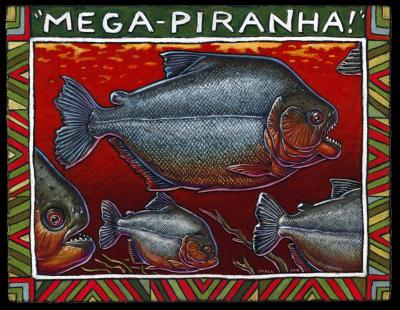
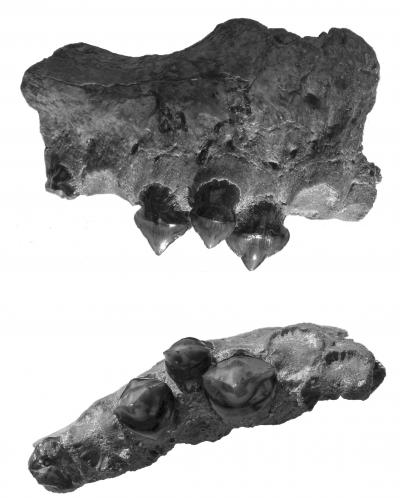
How did piranhas — the legendary freshwater fish with the razor bite — get their telltale teeth? Researchers from Argentina, the United States and Venezuela have uncovered the jawbone of a striking transitional fossil that sheds light on this question. Named Megapiranha paranensis, this previously unknown fossil fish bridges the evolutionary gap between flesh-eating piranhas and their plant-eating cousins. Present-day piranhas have a single row of triangular teeth, like the blade on a saw, explained the researchers. But their closest relatives — a group of fishes commonly known as pacus — have two rows of square teeth, presumably for crushing fruits and seeds. "In modern piranhas the teeth are arranged in a single file," said Wasila Dahdul, a visiting scientist at the National Evolutionary Synthesis Center in North Carolina. "But in the relatives of piranhas — which tend to be herbivorous fishes —the teeth are in two rows," said Dahdul.
Megapiranha shows an intermediate pattern: it's teeth are arranged in a zig-zag row. This suggests that the two rows in pacus were compressed to form a single row in piranhas. "It almost looks like the teeth are migrating from the second row into the first row," said John Lundberg, curator at the Academy of Natural Sciences in Philadelphia and a co-author of the study.
If this is so, Megapiranha may be an intermediate step in the long process that produced the piranha's distinctive bite. To find out where Megapiranha falls in the evolutionary tree for these fishes, Dahdul examined hundreds of specimens of modern piranhas and their relatives. "What's cool about this group of fish is their teeth have really distinctive features. A single tooth can tell you a lot about what species it is and what other fishes they're related to," said Dahdul. Her phylogenetic analysis confirms their hunch — Megapiranha seems to fit between piranhas and pacus in the fish family tree.
The Megapiranha fossil was originally collected in a riverside cliff in northeastern Argentina in the early 1900s, but remained unstudied until paleontologist Alberto Cione of Argentina's La Plata Museum rediscovered the startling specimen —an upper jaw with three unusually large and pointed teeth — in the 1980s in a museum drawer.
Cione's find suggests that Megapiranha lived between 8-10 million years ago in a South American river system known as the Paraná. But you wouldn't want to meet one today. If the jawbone of this fossil is any indication, Megapiranha was a big fish. By comparing the teeth and jaw to the same bones in present-day species, the researchers estimate that Megapiranha was up to 1 meter (3 feet) in length. That's at least four times as long as modern piranhas. Although no one is sure what Megapiranha ate, it probably had a diverse diet, said Cione.
Other riddles remain, however. "Piranhas have six teeth, but Megapiranha had seven," said Dahdul. "So what happened to the seventh tooth?"
"One of the teeth may have been lost," said Lundberg. "Or two of the original seven may have fused together over evolutionary time. It's an unanswered question. Maybe someday we'll find out."
Source: National Evolutionary Synthesis Center (NESCent)
Other sources
- PIRANHA PICTURES: Yard-long "Megapiranha" Fossil Foundfrom National GeographicFri, 26 Jun 2009, 22:28:20 UTC
- New fossil tells how piranhas got their teethfrom Biology News NetFri, 26 Jun 2009, 2:14:19 UTC
- New Fossil Tells How Piranhas Got Their Teethfrom Science DailyFri, 26 Jun 2009, 1:14:10 UTC
- Toothy 3-foot piranha fossil foundfrom MSNBC: ScienceThu, 25 Jun 2009, 23:56:18 UTC
- Toothy 3-foot Piranha Fossil Foundfrom Live ScienceThu, 25 Jun 2009, 21:42:14 UTC
- New fossil tells how piranhas got their teethfrom PhysorgThu, 25 Jun 2009, 21:14:09 UTC
- New fossil tells how piranhas got their teethfrom Science BlogThu, 25 Jun 2009, 20:35:06 UTC