


The coming of biofuels: Study shows reducing gasoline emissions will benefit human health
Related images
(click to enlarge)
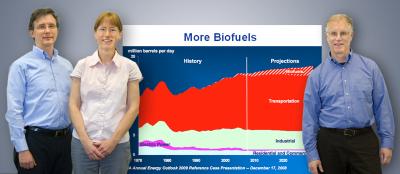

President Barack Obama and Energy Secretary Steve Chu are consistent in their message that when it comes to transportation fuels, carbon-neutral biofuels as an alternative to gasoline are coming. While the focus of a shift from gasoline to biofuels has been on global warming, such a shift could also impact human health. A grant from the Energy Biosciences Institute (EBI) has produced a novel and comprehensive "Life Cycle Impact Assessment" to measure the benefits on human health that might result from a switch to biofuels. Although there are a number of uncertainties that must be addressed for a more accurate picture, these early results show that a biofuel eliminating even 10-percent of current gasoline pollutant emissions would have a substantial impact on human health in this country, especially in urban areas. "While the successful deployment of biofuels requires research to overcome technical barriers, there are other barriers that can often impose constraints more challenging than those related to technical feasibility, including constraints imposed by health risks," says Thomas McKone, an expert on health risk assessments who holds a joint appointment with Berkeley Lab's Environmental Energy Technologies Division and the University of California Berkeley's School of Public Health. "Just think, if we had done a life cycle impact assessment on the human health effects of gasoline years ago we might not be in the situation we're facing today."
McKone is the co-leader of EBI's Life-Cycle Environmental and Economic Decision-Making for Alternative Biofuels programs with Arpad Horvath, an associate professor of civil and environmental engineering at UC Berkeley. At the recent 31st Symposium on Biotechnology for Fuels and Chemicals, conducted by the Society for Industrial Microbiology and held in San Francisco, he described a biofuels Life Cycle Impact Assessment (LCIA) that he carried out in collaboration with Agnes Lobscheid, an environmental scientist who also holds joint appointments with Berkeley Lab and UC Berkeley.
"In a typical LCIA, we evaluate the potential impact on human health and the environment of a product or activity holistically, by analyzing those effects over the entire life cycle of the product or activity," McKone said in his presentation. "For biofuels, we will ultimately need to look at the overall human health and environmental impacts of biomass production, converting and processing this biomass into fuel, storing, transporting and distributing that fuel, and finally the actual combustion and use of the biofuel."
EBI is a partnership between UC Berkeley, Berkeley Lab, the University of Illinois and BP, the energy corporation that has provided EBI with a 10-year $500-million grant. Part of its mission is to look into the environmental, social and economic dimensions of a transition to biofuels for transportation energy. In their initial LCIA, McKone and Lobscheid wanted to gain a better understanding of both life-cycle impacts and the distribution in space and time of these impacts for reduced gasoline use. To do this they first needed to define the factors that really matter for characterizing such impacts.
"For example, when looking at greenhouse gas emissions the key is to determine the total amount of emissions being vented into the atmosphere," McKone said. "However, when looking at the release of toxic pollutants, where the pollutants are being released can be more important than how much or even how toxic."
In preparing this LCIA on reduced gasoline use one of the biggest challenges faced by McKone and Lobscheid was the uncertainty factor in quantity, quality and relevance of their input data.
"Uncertainty was the elephant in the room for us," McKone said. "For an LCIA there are two types of uncertainties, those due to variability in measurements and models, and those due to lack of knowledge. In our case, the data is not what we would like and it will take years to improve it."
Nonetheless, McKone and Lobscheid were able to prepare an LCIA for reduced gasoline use based on the damage to human health that emissions from gasoline burning can cause. For a baseline, they used a 10-percent reduction in gasoline use. In assessing the impact of these emissions on human health they looked at "disability adjusted life years or "DALYs," which is a combination of two common damage factors in LCIAs - years of life lost due to premature mortality (YLLs) and the equivalent years of life lost due to disability (YLDs). One DALY is equal to one lost year of "healthy" life. To put this into perspective, the total annual disease burden in the United States is about 30 million DALYs.
"In looking at emission impacts on health. we have the capacity to carry out county-level resolution measurements for both direct and indirect emissions," said McKone in his SIM symposium presentation.
Measured emissions at county-level resolution included direct particulate matter and indirect fine particles (2.5 micrometers in diameter or smaller) produced from emissions of sulfate and nitrite gases, volatile organic compounds and ammonia, plus ozone, toxic air pollutants, emissions to surface and ground water, and emissions to soil.
"We found that for the vehicle operation phase of our LCIA, the annual health damages avoided in the U.S. with 10-percent less gasoline-run motor vehicle emissions ranges from about 5,000 to 20,000 DALY, with most of the damage resulting from primary fine particle emissions," said McKone. "While county-specific damages range over nine orders of magnitude across all U.S. counties most of the damage, as you would expect, is concentrated in urban populations with the highest impact in the Los Angeles, New York and Chicago regions."
Large urban regions also suffered disproportionate health damage as a result of benzene emissions at service stations and during the transporting by truck of gasoline to service stations - approximately 930 DALYs.
"We need finer spatial resolution about the impacts and more data on emissions factors, even for gasoline, to remove some of the key uncertainties about how fuel switching plays," said McKone, "but clearly impacts on human health should be a prime consideration in future fuel policy decisions."
Source: DOE/Lawrence Berkeley National Laboratory
Other sources
- The Coming Of Biofuels: Study Shows Reducing Gasoline Emissions Will Benefit Human Healthfrom Science DailyMon, 1 Jun 2009, 14:07:38 UTC
- The coming of biofuels: Study shows reducing gasoline emissions will benefit human healthfrom PhysorgThu, 28 May 2009, 17:56:15 UTC
- The coming of biofuels: Study shows reducing gasoline emissions will benefit human healthfrom Science BlogThu, 28 May 2009, 17:35:13 UTC
- Lower gas prices beat lower greenhouse gases in online surveyfrom PhysorgThu, 28 May 2009, 0:07:21 UTC