


Asteroid attack 3.9 billion years ago may have enhanced early life on Earth, says CU-Boulder study
Related images
(click to enlarge)
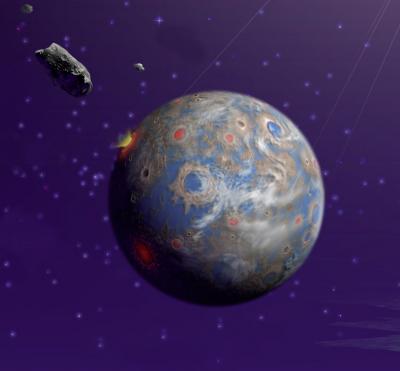
The bombardment of Earth nearly 4 billion years ago by asteroids as large as Kansas would not have had the firepower to extinguish potential early life on the planet and may even have given it a boost, says a new University of Colorado at Boulder study. Impact evidence from lunar samples, meteorites and the pockmarked surfaces of the inner planets paints a picture of a violent environment in the solar system during the Hadean Eon 4.5 to 3.8 billion years ago, particularly through a cataclysmic event known as the Late Heavy Bombardment about 3.9 million years ago. Although many believe the bombardment would have sterilized Earth, the new study shows it would have melted only a fraction of Earth's crust, and that microbes could well have survived in subsurface habitats, insulated from the destruction.
"These new results push back the possible beginnings of life on Earth to well before the bombardment period 3.9 billion years ago," said CU-Boulder Research Associate Oleg Abramov. "It opens up the possibility that life emerged as far back as 4.4 billion years ago, about the time the first oceans are thought to have formed."
A paper on the subject by Abramov and CU-Boulder geological sciences Professor Stephen Mojzsis appears in the May 21 issue of Nature.
Because physical evidence of Earth's early bombardment has been erased by weathering and plate tectonics over the eons, the researchers used data from Apollo moon rocks, impact records from the moon, Mars and Mercury, and previous theoretical studies to build three-dimensional computer models that replicate the bombardment. Abramov and Mojzsis plugged in asteroid size, frequency and distribution estimates into their simulations to chart the damage to the Earth during the Late Heavy Bombardment, which is thought to have lasted for 20 million to 200 million years.
The 3-D models allowed Abramov and Mojzsis to monitor temperatures beneath individual craters to assess heating and cooling of the crust following large impacts in order to evaluate habitability, said Abramov. The study indicated that less than 25 percent of Earth's crust would have melted during such a bombardment.
The CU-Boulder researchers even cranked up the intensity of the asteroid barrage in their simulations by 10-fold -- an event that could have vaporized Earth's oceans. "Even under the most extreme conditions we imposed, Earth would not have been completely sterilized by the bombardment," said Abramov.
Instead, hydrothermal vents may have provided sanctuaries for extreme, heat-loving microbes known as "hyperthermophilic bacteria" following bombardments, said Mojzsis. Even if life had not emerged by 3.9 billion years ago, such underground havens could still have provided a "crucible" for life's origin on Earth, Mojzsis said.
The researchers concluded subterranean microbes living at temperatures ranging from 175 degrees to 230 degrees Fahrenheit would have flourished during the Late Heavy Bombardment. The models indicate that underground habitats for such microbes increased in volume and duration as a result of the massive impacts. Some extreme microbial species on Earth today -- including so-called "unboilable bugs" discovered in hydrothermal vents in Yellowstone National Park -- thrive at 250 F.
Geologic evidence suggests that life on Earth was present at least 3.83 billion years ago, said Mojzsis. "So it is not unreasonable to suggest there was life on Earth before 3.9 billion years ago. We know from the geochemical record that our planet was eminently habitable by that time, and this new study sews up a major problem in origins of life studies by sweeping away the necessity for multiple origins of life on Earth."
Most planetary scientists believe a rogue planet as large as Mars smacked Earth with a glancing blow 4.5 billion years ago, vaporizing itself and part of Earth. The collision would have created an immense vapor cloud from which moonlets, and later our moon, coalesced, Mojzsis said. "That event, which preceded the Late Heavy Bombardment by at least 500 million years, would have effectively hit Earth's re-set button," he said.
"But our results strongly suggest that no events since the moon formation were capable of destroying Earth's crust and wiping out any biosphere that was present," Mojzsis said. "Instead of chopping down the tree of life, our view is that the bombardment pruned it."
The results also support the potential for microbial life on other planets like Mars and perhaps even rocky, Earth-like planets in other solar systems that may have been resurfaced by impacts, said Abramov.
"Exactly when life originated on Earth is a hotly debated topic," says NASA's Astrobiology Discipline Scientist Michael H. New, manager of the Exobiology and Evolutionary Biology program. "These findings are significant because they indicate life could have begun well before the LHB, during the so-called Hadean Eon of Earth's history 3.8 billion to 4.5 billion years ago."
Source: University of Colorado at Boulder
Other sources
- Study turns back clock on origins of life on Earthfrom Reuters:ScienceFri, 22 May 2009, 9:42:14 UTC
- How life may have outlasted early blastsfrom MSNBC: ScienceThu, 21 May 2009, 4:56:18 UTC
- Asteroid attack 3.9 billion years ago may have enhanced early life on Earth, says CU-Boulder studyfrom Biology News NetWed, 20 May 2009, 22:42:24 UTC
- How life may have outlasted early blastsfrom MSNBC: ScienceWed, 20 May 2009, 21:07:37 UTC
- Asteroids may have aided life on Earthfrom UPIWed, 20 May 2009, 20:56:08 UTC
- Asteroid Attack 3.9 Billion Years Ago May Have Enhanced Early Life On Earthfrom Science DailyWed, 20 May 2009, 20:21:03 UTC
- Life on Earth took a licking, kept on tickingfrom Sciencenews.orgWed, 20 May 2009, 19:42:14 UTC
- Study turns back clock on origins of life on Earthfrom Reuters:ScienceWed, 20 May 2009, 18:56:12 UTC
- Asteroid attack 4 billion years ago may have enhanced early life on Earthfrom PhysorgWed, 20 May 2009, 17:42:11 UTC
- Life Could Have Survived Earth's Early Bombardmentfrom Live ScienceWed, 20 May 2009, 17:14:25 UTC