


Afghanistan declares its first national park
Related images
(click to enlarge)
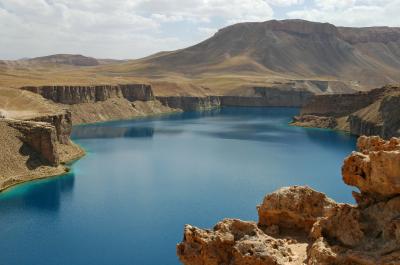
KABUL, AFGHANISTAN (EMBARGOED UNTIL WEDNESDAY, APRIL 22, 2009; 2:00 AM U.S. EASTERN TIME) – The United States Agency for International Development (USAID) and the Wildlife Conservation Society (WCS) applauded Afghanistan's National Environment Protection Agency (NEPA), which announced today the establishment of the country's first internationally recognized national park. USAID provided key funding that led to the park's creation, including support of WCS to conduct preliminary wildlife surveys, identify and delineate the park's boundaries, and work with local communities and the provincial government. WCS also developed the park's management plan, helped the government hire and train local rangers, and provided assistance to the Afghan Government to design the laws enabling the park to be created.
The park, known as Band-e-Amir, will protect one of Afghanistan's best-known natural areas: the spectacular series of six deep blue lakes separated by natural dams made of travertine, a mineral deposit. Travertine systems are found in only a few places throughout the world, virtually all of which are on the UNESCO World Heritage list and are major international tourist attractions.
Band-e-Amir had been a destination for travelers since the 1950s, with a peak visitation in the 1970s. Tourism was almost entirely absent during the war years between 1979-2001. Today, Band-e-Amir is visited every year by thousands of Afghan tourists and religious pilgrims as well as many foreigners currently living and working in-country. The park is near the Bamyan Valley, where the 1,500-year-old giant Buddha statues destroyed by the Taliban once stood.
"At its core, Band-e-Amir is an Afghan initiative supported by the international community. It is a park created for Afghans, by Afghans, for the new Afghanistan," said Dr. Steven E. Sanderson, President and CEO of the Wildlife Conservation Society. "Band-e-Amir will be Afghanistan's first national park and sets the precedent for a future national park system."
USAID applauded NEPA for the creation of the national park. USAID believes that protected areas are a key way to preserve natural resources while also improving local livelihoods.
Though much of the park's wildlife has been lost, recent surveys indicate that it still contains ibex (a species of wild goat) and urial (a type of wild sheep) along with wolves, foxes, smaller mammals and fish, and various bird species including the Afghan snow finch, which is believed to be the only bird found exclusively in Afghanistan. Snow leopards were once found in the area but vanished due to hunting in the early 1980s.
The lakes are under growing threat from pollution and other human-caused degradation to the fragile travertine dams.
Creating the national park will provide international recognition essential to helping develop Band-e-Amir as an international tourist destination, and assist it in obtaining World Heritage Status, which would provide additional protection. It also sets the groundwork to create an Afghan Protected Area System that could include the wildlife-rich transboundary area in the Pamirs shared by Afghanistan, Pakistan, China and Tajikistan.
The new park will be managed by Afghanistan's National Environmental Protection Agency, the Ministry of Agriculture, Irrigation and Livestock, and the Band-e-Amir Protected Area Committee. WCS helped the 13 villages lying within the park establish this Committee, which provides local input into all management decisions. The park will provide employment, tourism-derived revenue, and ensure that local communities play a key role in protecting this world class landscape.
Source: Wildlife Conservation Society
Other sources
- Afghanistan opens its first national parkfrom UPIThu, 23 Apr 2009, 21:56:24 UTC
- Afghanistan Declares Its First National Parkfrom Science DailyThu, 23 Apr 2009, 15:28:45 UTC
- Afghans get first national parkfrom BBC News: Science & NatureWed, 22 Apr 2009, 16:36:01 UTC
- Afghanistan's First National Park Protects Deep Blue Lakesfrom Live ScienceWed, 22 Apr 2009, 12:28:16 UTC
- Afghanistan Declares Its First National Parkfrom Newswise - ScinewsWed, 22 Apr 2009, 6:35:15 UTC