


'Green chemistry' could ease manufacture, boost usefulness of cancer drug
Related images
(click to enlarge)
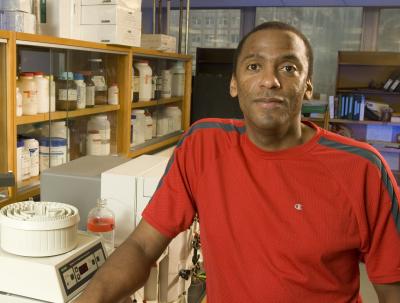
Research by Michigan State University chemist Kevin Walker is paving the way for potentially cleaner, more efficient production of cancer-fighting paclitaxel -- better known as the blockbuster drug Taxol. First isolated from the bark of the Pacific yew in 1967, paclitaxel has since been made by synthetically modifying an intermediate substance isolated from yew needles using toxic solvents or by fermenting cell cultures.
Walker's method employs natural enzymes instead. "Pharmaceutical companies could reduce the steps involved in making Taxol," he said, "while cutting chemical byproducts."
Walker, an assistant professor of chemistry, biochemistry and molecular biology, studies enzymes that assemble the Taxol molecule in Taxus plants. "This process is like painting from a palette," Walker said. "We can add select colors to the palette from which the enzyme chooses, so the molecule can be crafted in a variety of ways. The enzyme does all the work.
"A plant enzyme can do in one step what traditional synthetic construction does in multiples steps," Walker said. "Under our process, the construction of Taxol uses a biological assembly line where each enzyme does its job to create the final product. Particular enzymes on the assembly line can attach slightly different components on the molecular frame to create new-generation Taxol molecules. This can lead to more effective drug variants and eventually better health care treatment."
Taxol "is definitely a frontline drug and is used to treat many cancers," including those of the breast, lung, head and neck, said Barbara Conley, chief of the MSU Department of Medicine's hematology and oncology division.
With a world bulk paclitaxel market generating revenues of $195 million in 1997, potential new uses for conditions such as Alzheimer's disease and tuberculosis are expected to help boost the world market 10 percent by 2012, according to Global Industry Analysts Inc.
Walker's team's research was funded by the Michigan Agricultural Experiment Station. "The science and technology of plants and natural systems is becoming increasingly relevant in human medicine as scientists look for greater efficiencies and 'greener' ways of manufacturing drugs and other health care products," said MAES director Steve Pueppke. "Engaging in research that leads to improvements in human and animal health is a large and important part of the MAES mission."
Source: Michigan State University
Other sources
- 'Green Chemistry' Could Ease Manufacture, Boost Usefulness Of Cancer Drugfrom Science DailySat, 4 Apr 2009, 15:14:15 UTC
- 'Green chemistry' could ease manufacture, boost usefulness of cancer drug (w/Video)from PhysorgThu, 2 Apr 2009, 21:35:15 UTC