


Was Triceratops a social animal?
Related images
(click to enlarge)
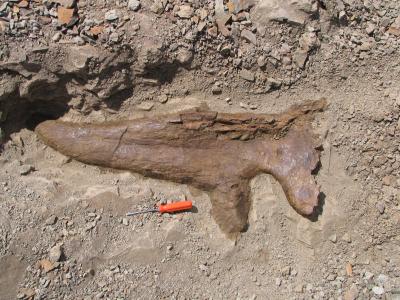
Until now, Triceratops was thought to be unusual among its ceratopsid relatives. While many ceratopsids—a common group of herbivorous dinosaurs that lived toward the end of the Cretaceous—have been found in enormous bonebed deposits of multiple individuals, all known Triceratops (over 50 in total) fossils have been solitary individuals. But a new discovery of a jumble of at least three juveniles the badlands of the north-central United States suggests that the three-horned dinosaurs were not only social animals, but may have exhibited unique gregarious groupings of juveniles. "This is very thrilling," says Stephen Brusatte, an affiliate of the American Museum of Natural History and a doctoral student at Columbia University. "We can say something about how these dinosaurs lived. Interestingly, what we've found seems to be a larger pattern among many dinosaurs that juveniles lived and traveled together in groups."
In 2005, Brusatte and colleagues found and excavated a site that contained multiple Triceratops juveniles in 66-million-year-old rocks in southeastern Montana. The geological evidence suggests that at least three juveniles were deposited at the same time by a localized flood, and this suggests that they were probably living together when disaster struck. This find indicates that Triceratops juveniles congregated in small herds, a social behavior increasingly identified in other dinosaur groups, such as Psittacosaurus, a small cousin of Triceratops that lived in Asia.
"We don't know why they were grouped together or how much time they spent together," says Joshua Mathews of the Burpee Museum of Natural History and Northern Illinois University, who led the project. "Herding together could have been for protection, and our guess is that this wasn't something they did full time."
The site was discovered in 2005 by Burpee Museum volunteer Helmuth Redschlag. Redschlag, a devoted fan of The Simpsons television program, named the bonebed the "Homer Site."
"It's kind of fitting that these big, bulky, plodding Triceratops are named after Homer Simpson," says Brusatte. "But more than anything, we were able to find something shockingly unexpected, even though there are more Triceratops skeletons than [there are of] nearly any other dinosaur, and southeastern Montana has been combed for fossils for hundreds of years." Excavation at the Homer Site is ongoing, and the Burpee Museum team expects to find additional fossils of Triceratops juveniles.
Source: American Museum of Natural History
Other sources
- Was Triceratops a social animal?from Biology News NetTue, 24 Mar 2009, 21:21:17 UTC
- Teen dinosaurs were gregarious gangstersfrom MSNBC: ScienceTue, 24 Mar 2009, 17:56:13 UTC
- Gang of Juvenile Dinosaurs Discoveredfrom Live ScienceTue, 24 Mar 2009, 14:42:50 UTC
- Triceratops Was A Social Animal, According To New Fossil Discoveryfrom Science DailyTue, 24 Mar 2009, 13:14:51 UTC
- Was Triceratops a social animal?from PhysorgTue, 24 Mar 2009, 11:42:15 UTC