


Wild grass became maize crop more than 8,700 years ago
Related images
(click to enlarge)
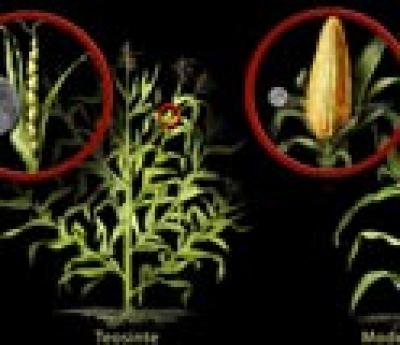
The earliest physical evidence for domesticated maize, what some cultures call corn, dates to at least 8,700 calendar years ago, and it was probably domesticated by indigenous peoples in the lowland areas of southwestern Mexico, not the highland areas. This new evidence comes from an international team of researchers, who report the findings in two companion papers in this week's Proceedings of the National Academy of Sciences. They place maize domestication in Mexico about 1,500 years earlier than previously documented there and 1,200 years earlier than the next earliest dated evidence for maize in Panama.
"Our primary goal was to document the early history of maize domestication in the homeland of its wild ancestor," said Anthony Ranere, Department of Anthropology at Temple University, Philadelphia, Pa. He acknowledged the timelines make a good deal of sense because the wild ancestor of maize is native to the regions of southwestern Mexico where the team worked, and these regions had not been previously explored by archaeologists.
Researchers focused on the Xihuatoxtla Shelter in an area of the Balsas Valley that is home to a large, wild grass called Balsas teosinte that molecular biologists recently identified as the ancestor of maize. The shelter contained early maize and squash remains as well as ancient stone tools used to grind and mill the plants.
"We found the remains of maize and squash in many contexts from the earliest occupation levels," said Dolores Piperno, senior scientist and curator of archaeobotany and South American archaeology for the Smithsonian's Museum of Natural History in Washington, D.C. "This indicates these two crops were being routinely consumed nearly 9,000 years ago."
Ranere and Piperno discuss both the archaeological context and botanical evidence for maize and squash domestication in the papers published in the Proceedings of the National Academy of Sciences. Ranere is the first author of the archaeological paper, while Piperno is the first author of the botanical paper. Both papers result from work by the same five investigators, including Irene Holst, Smithsonian Tropical Research Institute, Panama; Jose Iriarte, University of Exeter, U.K.; and Ruth Dickau, Temple University. The research is partially funded by the National Science Foundation.
"Finding early human settlements in this part of Mexico is also very important, as it shows people were becoming well-adapted to tropical forest settings early on," said Piperno. The findings suggest domestication of maize in Mexico's lowland areas as opposed to highland areas as has long been thought.
The search for maize origins in the 1950s through the 1970s focused on arid or semi-arid regions in the Mexican highlands where preservation of dried out plant remains was common. Not surprisingly, the earliest maize remains in the form of maize cobs and kernels came from highland caves and rock shelters.
But search locations shifted when molecular biologists began to study where the ancestor of maize, teosinte, grows today and when researchers began using phytoliths and starch grains to identify maize and other plant species, both domesticated and wild, in the 1990s. Starch grains and phytoliths are microscopic particles that occur in leafs, stems and roots of many plants, and unlike whole seeds and roots are well-preserved in tropical forest environments, such as those in lowland areas of Mexico and Panama.
Even more, phytolith and starch grain evidence allowed researchers to trace the dispersal of maize as a domesticated crop from its origin in or around the Balsas Valley to Panama by 7,600 years ago and shortly thereafter to Colombia and Ecuador, and to Uruguay by 4,600 years ago.
The researchers acknowledge, however, that maize already appears to have been domesticated in the earliest occupation of the Xihuatoxtla Shelter. "We did not find evidence for the earliest stages in the domestication process," said Ranere. "We need to find more ancient deposits in order to document the beginning of the process."
Source: National Science Foundation
Articles on the same topic
- New research reveals the earliest evidence for corn in the New WorldMon, 23 Mar 2009, 21:38:54 UTC
- Researchers find the earliest evidence of domesticated maizeMon, 23 Mar 2009, 21:38:51 UTC
Other sources
- Earliest Evidence Of Domesticated Maize Discovered: Dates Back 8,700 Yearsfrom Science DailyWed, 25 Mar 2009, 1:21:38 UTC
- New research reveals the earliest evidence for corn in the New Worldfrom Biology News NetTue, 24 Mar 2009, 1:49:21 UTC
- Researchers Find the Earliest Evidence of Domesticated Maizefrom Newswise - ScinewsMon, 23 Mar 2009, 21:49:24 UTC
- Researchers find the earliest evidence of domesticated maizefrom PhysorgMon, 23 Mar 2009, 21:21:25 UTC