


Novel electric signals in plants
Related images
(click to enlarge)
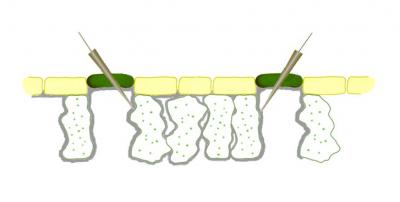
Using ion-selective micro-electrodes electrical signals in plants moving from leaf to leaf could be measured. The speed of the signals spreading as voltage changes over cell membranes ranged from 5 to 10 cm per minute. The scientists discovered this new kind of electrical signal transmission system by applying a novel method: Filamentary electrodes were inserted through open stomata directly into the inner leaf tissue and then placed onto the cell walls (see picture). Stomata are microscopically small openings in the leaf surface which plants facilitate regulating evaporation and gas exchange. The scientists found out that the new electrical signal they called "system potential" was induced and even modulated by wounding. If a plant leaf is wounded, the signal strength can be different and can be measured over long distances in unwounded leaves, depending on the kind and concentration of added cations (e.g. calcium, potassium, or magnesium). It is not the transport of ions across cell membranes that causes the observed changes in voltage transmitted from leaf to shoot and then to the next leaf, but the activation of so-called proton pumps. "This is the reason why the "system potential" we measured cannot at all be compared to the classic action potential as present in nerves of animals and also in plants", says Hubert Felle from Gießen University. Action potentials follow all-or-none characteristics: they are activated if a certain stimulus threshold is reached and then spread constantly. The "system potential", however, can carry different information at the same time: The strength of the inducing stimulus (wound signal) can influence the amplitude of the systemic signal as well as the effect of different ions. "We may be on the trail of an important signal transmission system that is induced by insect herbivory. Within minutes the whole plant is alerted and the plant's defense against its enemy is activated", says Axel Mithöfer from the Max Planck Institute for Chemical Ecology in Jena.
The novel "system potential" was detected in five different plant species, among them agricultural crops like tobacco (Nicotiana tabacum), maize (Zea mays), barley (Hordeum vulgare), and field bean (Vicia faba).
Source: Max Planck Institute for Chemical Ecology
Other sources
- Novel Electric Signals In Plants Induced By Wounding Plantfrom Science DailyMon, 9 Mar 2009, 16:50:30 UTC
- Novel electric signals in plantsfrom PhysorgMon, 9 Mar 2009, 15:21:29 UTC