


Fermilab collider experiments discover rare single top quark
Related images
(click to enlarge)
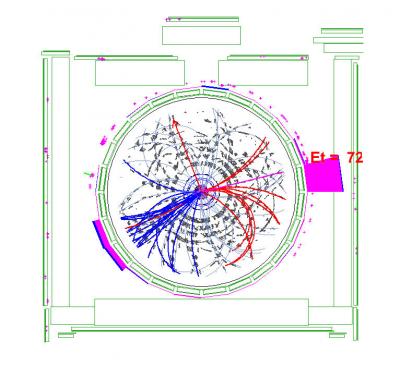
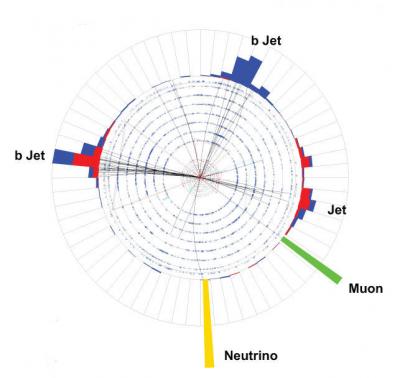
Scientists of the CDF and DZero collaborations at the Department of Energy's Fermi National Accelerator Laboratory have observed particle collisions that produce single top quarks. The discovery of the single top confirms important parameters of particle physics, including the total number of quarks, and has significance for the ongoing search for the Higgs particle at Fermilab's Tevatron, currently the world's most powerful operating particle accelerator. Previously, top quarks had only been observed when produced by the strong nuclear force. That interaction leads to the production of pairs of top quarks. The production of single top quarks, which involves the weak nuclear force and is harder to identify experimentally, has now been observed, almost 14 years to the day of the top quark discovery in 1995.
Searching for single-top production makes finding a needle in a haystack look easy. Only one in every 20 billion proton-antiproton collisions produces a single top quark. Even worse, the signal of these rare occurrences is easily mimicked by other "background" processes that occur at much higher rates.
"Observation of the single top quark production is an important milestone for the Tevatron program," said Dr. Dennis Kovar, Associate Director of the Office of Science for High Energy Physics at the U.S. Department of Energy. "Furthermore, the highly sensitive and successful analysis is an important step in the search for the Higgs."
Discovering the single top quark production presents challenges similar to the Higgs boson search in the need to extract an extremely small signal from a very large background. Advanced analysis techniques pioneered for the single top discovery are now in use for the Higgs boson search. In addition, the single top and the Higgs signals have backgrounds in common, and the single top is itself a background for the Higgs particle.
To make the single-top discovery, physicists of the CDF and DZero collaborations spent years combing independently through the results of proton-antiproton collisions recorded by their experiments, respectively. Each team identified several thousand collision events that looked the way experimenters expect single top events to appear. Sophisticated statistical analysis and detailed background modeling showed that a few hundred collision events produced the real thing. On March 4, the two teams submitted their independent results to Physical Review Letters.
The two collaborations earlier had reported preliminary results on the search for the single top. Since then, experimenters have more than doubled the amount of data analyzed and sharpened selection and analysis techniques, making the discovery possible. For each experiment, the probability that background events have faked the signal is now only one in nearly four million, allowing both collaborations to claim a bona fide discovery that paves the way to more discoveries.
"I am thrilled that CDF and DZero achieved this goal," said Fermilab Director Pier Oddone. "The two collaborations have been searching for this rare process for the last fifteen years, starting before the discovery of the top quark in 1995. Investigating these subatomic processes in more detail may open a window onto physics phenomena beyond the Standard Model."
Source: DOE/Fermi National Accelerator Laboratory
Articles on the same topic
- Brown physicists play key role in single top quark discoveryMon, 9 Mar 2009, 20:51:04 UTC
- Research team co-led by UC Riverside physicist observes production of single-top-quarksMon, 9 Mar 2009, 18:08:15 UTC
Other sources
- Rare Single Top Quark Discovered In Collider Experimentsfrom Science DailyTue, 10 Mar 2009, 3:28:29 UTC
- Fermilab collider experiments discover rare single top quarkfrom PhysorgMon, 9 Mar 2009, 15:21:07 UTC