


Caltech scientists create titanium-based structural metallic-glass composites
Related images
(click to enlarge)
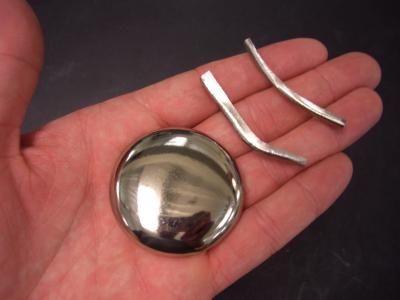
Scientists from the California Institute of Technology (Caltech) have created a range of structural metallic-glass composites, based in titanium, that are lighter and less expensive than any the group had previously created, while still maintaining their toughness and ductility--the ability to be deformed without breaking. A paper describing these breakthrough metallic-glass alloys is now online in the Proceedings of the National Academy of Sciences (PNAS) Early Edition in advance of an upcoming print publication.
Earlier this year, the same Caltech group had published a paper in the journal Nature, describing new strategies for creating the liquid-metal composites. This research resulted in "alloys with unrivaled strength and toughness," notes Douglas Hofmann, visiting scientist and lead author on the PNAS paper that, along with the Nature paper, describes work he did while a graduate student at Caltech. "They are among the toughest engineering materials that currently exist."
Still, there were shortcomings to the alloys presented in Nature. Because they were created for use in the aerospace industry--among other structural applications--they needed to have very low densities. Ideally, the alloys would have had densities in or around those of crystalline titanium alloys, which fall between 4.5 and 5 grams per cubic centimeter (g/cc). The original alloys, made predominantly of zirconium, fell between 5.6 and 6.4 g/cc, putting them "in a no-man's-land of densities for aerospace structures," says Hofmann.
And so Hofmann and his colleagues--including William Johnson, Caltech's Ruben F. and Donna Mettler Professor of Engineering and Applied Science, and a pioneer in the creation of metallic glass--began tweaking the components in their composites, eventually coming up with a group of alloys with a high percentage of titanium, but which maintained the properties of the previously created zirconium alloys.
"Despite being based in titanium," Hofmann notes, "these alloys exhibit the same impressive properties as the zirconium alloys. They are still tough--in other words, they resist cracking--and they are still ductile. In fact, they are even more ductile than the alloys we'd created in the past."
This decrease in density also resulted in a reduction in cost, adds Hofmann, since zirconium is a more expensive metal than is titanium.
Source: California Institute of Technology
Other sources
- Scientists create titanium-based structural metallic-glass compositesfrom PhysorgFri, 19 Dec 2008, 19:07:07 UTC