


K-State engineers helping develop energy-harvesting radios
Related images
(click to enlarge)
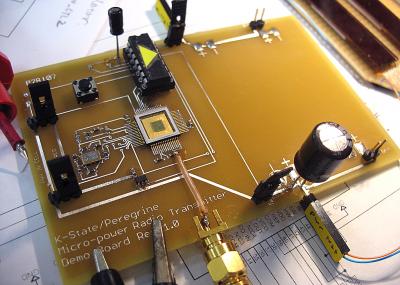
If changing the batteries in the remote control or smoke detector seems like a chore, imagine having to change hundreds of batteries in sensors scattered across a busy bridge. That's why Kansas State University engineers are helping a semiconductor manufacturer implement its idea of an energy-harvesting radio. It could transmit important data -- like stress measurements on a bridge, for instance -- without needing a change of batteries, ever.
Bill Kuhn, K-State professor of electrical and computer engineering, and Xiaohu Zhang, master's student in electrical engineering, are developing an energy-harvesting radio for Peregrine Semiconductor, a San Diego-based integrated circuit manufacturer.
"This type of radio technology may exist in your house, for instance if you have a temperature sensor outside that radios data to a display inside," Kuhn said. "But those devices need to have their batteries changed. This radio doesn't."
Peregrine Semiconductor is looking at possible applications for the technology. This could include monitoring stress, temperature and pressure on bridges and other structures. Ron Reedy, Peregrine's chief technical officer, said that fulfilling this vision of autonomous sensors requires highly integrated, low power radio chips -- exactly the kind that K-State and Peregrine have demonstrated to NASA's Jet Propulsion Laboratory on Peregrine's trademarked UltraCMOS silicon-on-sapphire technology.
Meanwhile, the K-State engineers are looking at the design challenges of a radio system like this. Kuhn and Zhang have been working on the project for a little more than a year. They are creating a demonstration to test how far the signals can travel from the sensors.
Zhang constructed a demonstration board using solar cells from inexpensive calculators to power the radio. The board has capacitors that capture and store the light energy to power the radio without a battery. Although this prototype captures and stores light energy, Kuhn said that energy-harvesting radios could be powered by a number of different ways, including by electrochemical, mechanical or thermal energy.
The demonstration board that Zhang created includes a microprocessor to store data before it's transmitted via radio. The radio used is the "Mars chip" that Kuhn helped develop in a successful project he and a team from K-State, Cal Tech's Jet Propulsion Laboratory and Peregrine Semiconductor did for NASA. They developed a micro transceiver to use on Mars rovers and scouts. In 2007, the work was published in Proceedings of the Institute of Electrical and Electronics Engineers.
In this way, Kuhn said the energy-harvesting radio they are working on now is an example of a NASA spinoff -- that is, technology developed for space exploration that can be used here on Earth.
When the stored data is ready to be transmitted, the radio sends out a data-burst. In Zhang's model, this happens every five seconds. It may just sound like a "blip," but that burst contains data that a computer can translate into meaningful information, such as telling an engineer the stress or strain on the underside of a bridge. Kuhn said that it's kind of like sending a text message from one cell phone to another: After data are transmitted through the air, the recipient's cell phone turns that data back into text that can be understood.
Kuhn and Zhang are stepping in to perfect the radio system design. This includes determining which frequencies to use based on how the environment affects radio waves indoors versus outdoors. They also have to look at how noise and other factors may limit the sensitivity of the receiver that's getting the data from all of the sensors.
Because these sensors save data in their microprocessors, Kuhn and Zhang are working on timing and wake-up commands that tell the sensors when to send the stored information to the receiver. Through engineering analysis, they are determining tradeoffs between power requirements, data-rate and transmission range issues.
Source: Kansas State University
Other sources
- Engineers Developing Energy-harvesting Radiosfrom Science DailyWed, 17 Dec 2008, 4:21:20 UTC
- K-State engineers helping develop energy-harvesting radiosfrom PhysorgTue, 16 Dec 2008, 17:51:36 UTC
- Engineers Working with Peregrine Semiconductor to Develop Energy-harvesting Radios That Could Make Monitoring Safety of Bridges Easierfrom Newswise - ScinewsTue, 16 Dec 2008, 17:14:13 UTC