


Brown dwarfs do form like stars
Related images
(click to enlarge)
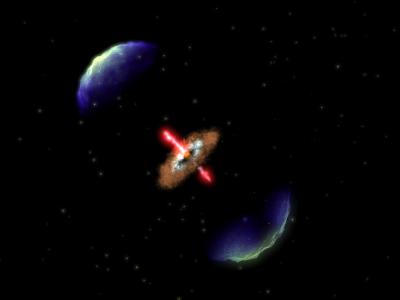

Astronomers have uncovered strong evidence that brown dwarfs form like stars. Using the Smithsonian's Submillimeter Array (SMA), they detected molecules of carbon monoxide shooting outward from the object known as ISO-Oph 102. Such molecular outflows typically are seen coming from young stars or protostars. However, this object has an estimated mass of 60 Jupiters, meaning it is too small to be a star. Astronomers have classified it as a brown dwarf. Brown dwarfs are on the dividing line between planets and stars, and generally have masses between 15 and 75 Jupiters. (The theoretical minimum mass for a star to sustain nuclear fusion is 75 times Jupiter.) As a result, brown dwarfs are sometimes called failed stars. However, it is not clear whether they form like stars, from the gravitational collapse of gas clouds, or if they form like planets, agglomerating rocky material until they grow massive enough to draw in nearby gas.
A star forms when a cloud of interstellar gas draws itself together through gravity, growing denser and hotter until fusion ignites. If the initial gas cloud is rotating, that rotation will speed up as it collapses inward, much like an ice skater drawing her arms in. In order to gather mass, the young protostar must somehow shed that angular momentum. It does so by spewing material in opposite directions as a bipolar outflow.
A brown dwarf is less massive than a star, so there is less gravity available to pull it together. As a result, astronomers debated whether a brown dwarf could form the same way as a star. Previous observations provided hints that they could. The serendipitous discovery of a bipolar molecular outflow at ISO-Oph 102 offers the first strong evidence in favor of brown dwarf formation through gravitational collapse.
"We thought that any such outflow would be too weak to detect with current facilities and would have to wait until a next-generation instrument like ALMA [the Atacama Large Millimeter Array]," said Ngoc Phan-Bao of the Academia Sinica Institute of Astronomy and Astrophysics (ASIAA), lead author on the paper announcing the find. "This was a big surprise. Finding the molecular outflow with the SMA shows the extraordinary capabilities of the array."
As might be expected, the outflow contains much less mass than the outflow from a typical star: about 1000 times less, in fact. The outflow rate is also smaller by a factor of 100. In all respects, the molecular outflow of ISO-Oph 102 is a scaled-down version of the outflow process seen in young stars.
"These findings suggest that brown dwarfs and stars aren't different because they formed in different ways," said Paul Ho, an astronomer at the Harvard-Smithsonian Center for Astrophysics and director of ASIAA. "They share the same formation mechanism. Whether an object ends up as a brown dwarf or star apparently depends only on the amount of available material."
Source: Harvard-Smithsonian Center for Astrophysics
Other sources
- Brown Dwarfs Do Form Like Starsfrom Science DailyThu, 4 Dec 2008, 14:28:08 UTC
- Brown dwarfs do form like starsfrom PhysorgWed, 3 Dec 2008, 17:36:02 UTC
- Strong evidence brown dwarfs form like starsfrom Harvard ScienceWed, 3 Dec 2008, 16:35:17 UTC