


Light pollution offers new global measure of coral reef health
Related images
(click to enlarge)
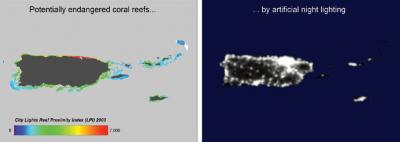
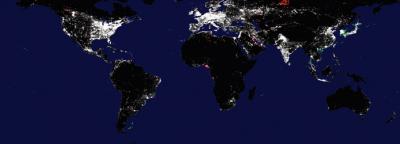
We've all seen the satellite images of Earth at night--the bright blobs and shining webs that tell the story of humanity's endless sprawl. These pictures are no longer just symbols of human impact, however, but can be used to objectively measure it, according to a study in the December 2008 issue of Geocarto International, a peer-reviewed journal on geoscience and remote sensing.
Travis Longcore, a USC geographer and expert in light pollution, collaborated with an international team, led by Christoph Aubrecht of the Austrian Research Centers, to develop the index.
"Coral reefs are incredibly important—but unfortunately they're also incredibly fragile," Longcore said. "Using night light proximity, we were able to identify the most threatened and most pristine spots in an objective and easily repeatable way."
The researchers did this by first classifying the light into three separate sources: urban areas, gas flares and fishing boat activity.
Each of these sources puts stress on reefs: urban areas cause sewage and polluted runoff, oil platforms cause leakages and spills, and commercial fishing boats deplete marine life and impair the ecological balance.
The closer a reef is to one or more of these sources, the higher the index number and the greater the stress on the reefs.
While previous assessments of coral reef health, like the 1998 Reefs at Risk survey, considered more variables, the LPI yields similar results, Longcore added.
"As a first-pass global assessment, light pretty much correlates with human impact on the oceans," he explained.
Light's direct impact on coral reefs
In this way the index uses light as an indirect measure of coral reef health, which could help inform conservation policy.
But the LPI is also a direct measurement of coral reef stress, since light itself also affects marine life, according to the study.
"The lights themselves are a stress in terms of changing the ecology in the environments around them," Longcore explained.
In 2002, Longcore and his colleague Catherine Rich of The Urban Wildlands Group organized a conference for scientists studying light. In 2006, Rich and Longcore co-edited a book on the subject called "Ecological Consequences of Artificial Night Lighting."
Since then, Longcore has been at the forefront of widening interest in light pollution and its effects on human and environmental health. (For example, National Geographic's cover story this month is on light pollution.)
"It used to be you couldn't find light pollution and wildlife together, except in a few white papers," Longcore said.
Increasingly, concerns about artificial lighting extend beyond star enthusiasts to environmental and human health issues, he added.
In terms of coral reefs, more research is needed on light's direct effects, but lab studies show that light can disrupt coral reproduction, which is timed to moonlight.
"Light at levels that would seem insignificant to humans can be incredibly significant to marine organisms and even terrestrial organisms," Longcore said.
As a rule of thumb, artificial light tends to benefit predators, which is why many organisms rely on darkness to maximize their odds of survival.
Light can also disrupt migration patterns of birds. In fact, Shell and Philips recently teamed up to change the lighting schemes on North Sea oilrigs for this reason.
In addition, communications towers, mainly because of their flashing lights, attract and kill about 4-5 million birds a year in North America, Longcore noted.
Yet despite its significance, light pollution is only one of many stresses facing coral reefs, which act synergistically to threaten their survival.
More on the study
The researchers used data from the Defense Meteorological Satellite Program (DMSP), which was initially designed to detect moonlit clouds.
The model found that in terms of proximity to urban light, coral reefs in Singapore, the Red Sea, Barbados, Puerto Rico, and Bahrain have the highest index values.
In terms of fishing boat activity, coral reefs in the Gulf of Thailand, off the west coast of Thailand, and in China have the highest LPI values. And in terms of gas flares, Bahrain and the Persian Gulf show the highest values.
Coral reefs in Indonesia, Malaysia and the Philippines rate high in terms of a coincidence of all three light sources.
Places with very low LPI values were the Great Barrier Reef, the Marshall Islands, Madagascar, and the Cargados Carajos Shoals near Mauritius.
Source: University of Southern California
Other sources
- Light Pollution Offers New Global Measure Of Coral Reef Healthfrom Science DailyWed, 26 Nov 2008, 16:28:21 UTC
- Light pollution can measure reef healthfrom UPITue, 25 Nov 2008, 22:42:08 UTC
- Light pollution offers new global measure of coral reef healthfrom PhysorgMon, 24 Nov 2008, 23:21:31 UTC