


Extreme weather postpones the flowering time of plants
Related images
(click to enlarge)
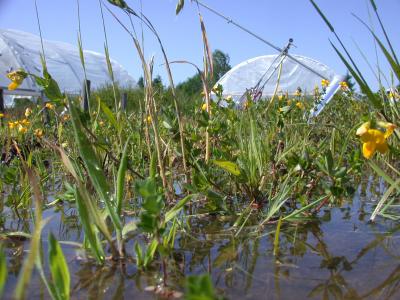
Bayreuth/Leipzig. Extreme weather events have a greater effect on flora than previously presumed. A one-month drought postpones the time of flowering of grassland and heathland plants in Central Europe by an average of 4 days. With this a so-called 100-year drought event equates to approx. a decade of global warming. The flowering period of an important early flowerer, the common Birds-foot Trefoil (Lotus corniculatus) was even shortened by more than a month due to heavy rain and started flowering early by almost one month. In a study conducted by the University of Bayreuth and the Helmholtz-Centre for Environmental Research (UFZ) researchers came to this conclusion. Using experimental plots in Bayreuth the researchers generated artificial heavy rain and drought in their experiment and the effects on ten different plant species were observed accordingly over a two-year period. With climate change it is expected that such extreme weather events will increase in frequency and intensity, which entails a risk for animal-plant interactions and ecological services. In this respect it is conceivable that the synchronisation between flowering plants and pollinating insects could be uncoupled and the rhythm of evolution lost due to extreme weather events. For example, the activity of pollinating insects is determined more so by temperatures as opposed to changes in rainfall, as researchers have reported in the scientific journal Global Change Biology. Changes to the flowering time of plants are regarded as one of the most evident signs of global warming. Other studies have already shown that since 1960 the beginning of Spring has been postponed in the northern hemisphere by an average of 2.5 days per decade. Although forecasts like the IPCC-Report 2007 reckon with a more considerable increase in extreme weather events, the effects of such events on ecology have previously been researched very little. Scientists working with Prof. Anke Jentsch have therefore set up an experimental site in the ecological botanical garden in Bayreuth, to investigate the effects of extreme weather events such as droughts or heavy rains. The investigation area with an average annual temperature of 8.2º C and 724 millimeters annual rainfall is situated in a transitional zone between the Atlantic and Continental climates. One hundread plants of each widely distributed species like for example Yorkshire Fog (Holcus lanatus), Ribwort Plantain (Plantago lanceolata) and Heather (Calluna vulgaris) were planted on each of 30 4m2 experimental plots. Using plastic tarpaulin covers the researchers were able to simulate an extreme dry period of 32 days and a period of extreme rain using artificial rain with 170 millimeters of rainfall lasting 14 days, corresponding to a local 100-year extreme weather event. Both simulations correspond to the historical highest values that were recorded in Bayreuth in the summer of 1976 and 1977. The sites were observed over two years and the flowering time of all plants recorded. During this period it transpired that two weeks of heavy rain shortened the flowering period by 3 to 5 days, and in the case of an important spring-time the flowering period was even shortened by 37 days and started 26 days earlier. Conversely with a long drought period of one month: on average the plants flowered in total for four days longer and also four days earlier than usual. "A single extreme drought can therefore have similar effects on flowering as a decade of global warming", explains Anke Jentsch. "The climate change with more frequent extreme weather events will have extensive consequences for ecosystems and interactions between species."
Source: Helmholtz Association of German Research Centres
Other sources
- Extreme Weather Postpones Flowering Time Of Plantsfrom Science DailyWed, 5 Nov 2008, 16:28:07 UTC
- Extreme weather postpones the flowering time of plantsfrom PhysorgWed, 5 Nov 2008, 15:21:18 UTC