


'Living fossil' tree contains genetic imprints of rain forests under climate change
Related images
(click to enlarge)
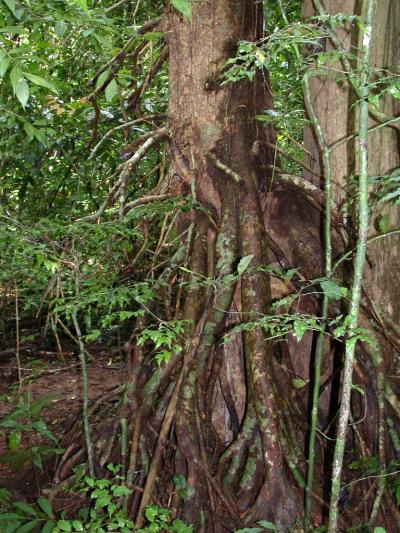
A "living fossil" tree species is helping a University of Michigan researcher understand how tropical forests responded to past climate change and how they may react to global warming in the future. The research appears in the November issue of the journal Evolution.
Symphonia globulifera is a widespread tropical tree with a history that goes back some 45 million years in Africa, said Christopher Dick, an assistant professor of ecology and evolutionary biology who is lead author on the paper. It is unusual among tropical trees in having a well-studied fossil record, partly because the oil industry uses its distinctive pollen fossils as a stratigraphic tool.
About 15 to 18 million years ago, deposits of fossil pollen suggest, Symphonia suddenly appeared in South America and then in Central America. Unlike kapok, a tropical tree with a similar distribution that Dick also has studied, Symphonia isn't well-suited for traveling across the ocean---its seeds dry out easily and can't tolerate saltwater. So how did Symphonia reach the neotropics? Most likely the seeds hitched rides from Africa on rafts of vegetation, as monkeys did, Dick said. Even whole trunks, which can send out shoots when they reach a suitable resting place, may have made the journey. Because Central and South American had no land connection at the time, Symphonia must have colonized each location separately.
Once Symphonia reached its new home, it spread throughout the neotropical rain forests. By measuring genetic diversity between existing populations, Dick and coworker Myriam Heuertz of the Université Libre de Bruxelles were able to reconstruct environmental histories of the areas Symphonia colonized.
"For Central America, we see a pattern in Symphonia that also has been found in a number of other species, with highly genetically differentiated populations across the landscape," Dick said. "We think the pattern is the result of the distinctive forest history of Mesoamerica, which was relatively dry during the glacial period 10,000 years ago. In many places the forests were confined to hilltops or the wettest lowland regions. What we're seeing in the patterns of genetic diversity is a signature of that forest history."
In the core Amazon Basin, which was moist throughout the glacial period, allowing for more or less continuous forest, less genetic diversity is found among populations, Dick said. "There's less differentiation across the whole Amazon Basin than there is among sites in lower Central America."
The study is the first to make such comparisons of genetic diversity patterns in Central and South America. "We think similar patterns will be found in other widespread species," Dick said.
Learning how Symphonia responded to past climate conditions may be helpful for predicting how forests will react to future environmental change, Dick said.
"Under scenarios of increased warmth and drying, we can see that populations are likely to be constricted, particularly in Central America, but also that they're likely to persist, because Symphonia has persisted throughout Central America and the Amazon basin. That tells us that some things can endure in spite of a lot of forest change. However, past climate changes were not combined with deforestation, as is the case today. That combination of factors could be detrimental to many species---especially those with narrow ranges---in the next century."
Source: University of Michigan
Other sources
- 'Living fossil' tree contains genetic imprints of rain forests under climate changefrom Biology News NetSat, 1 Nov 2008, 23:36:07 UTC
- 'Living fossil' tree contains genetic imprints of rain forests under climate changefrom Science BlogFri, 31 Oct 2008, 21:35:20 UTC
- Scientists discover cloud-thickening chemicals in trees that could offer a new weapon in the fight against global warmingfrom The Guardian - ScienceFri, 31 Oct 2008, 16:56:21 UTC
- 'Living fossil' tree contains genetic imprints of rain forests under climate changefrom Science BlogFri, 31 Oct 2008, 13:07:41 UTC
- 'Living Fossil' Tree Contains Genetic Imprints Of Rain Forests Under Climate Changefrom Science DailyFri, 31 Oct 2008, 2:14:17 UTC
- "Living Fossil" Tree Contains Genetic Imprints of Rain Forests Under Climate Changefrom Newswise - ScinewsFri, 31 Oct 2008, 1:21:07 UTC
- 'Living fossil' tree contains genetic imprints of rain forests under climate changefrom Biology News NetFri, 31 Oct 2008, 0:56:42 UTC
- 'Living fossil' tree contains genetic imprints of rain forests under climate changefrom PhysorgThu, 30 Oct 2008, 21:56:14 UTC