


Astronomers get best view yet of infant stars at feeding time
Related images
(click to enlarge)
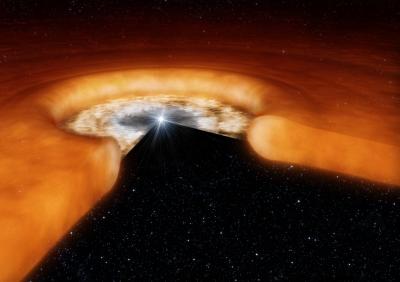
Astronomers have used ESO's Very Large Telescope Interferometer to conduct the first high resolution survey that combines spectroscopy and interferometry on intermediate-mass infant stars. They obtained a very precise view of the processes acting in the discs that feed stars as they form. These mechanisms include material infalling onto the star as well as gas being ejected, probably as a wind from the disc. Infant stars form from a disc of gas and dust that surrounds the new star and, later, may also provide the material for a planetary system. Because the closest star-forming regions to us are about 500 light-years away, these discs appear very small on the sky, and their study requires special techniques to be able to probe the finer details.
This is best done with interferometry, a technique that combines the light of two or more telescopes so that the level of detail revealed corresponds to that which would be seen by a telescope with a diameter equal to the separation between the interferometer elements, typically 40 to 200 metres. ESO's Very Large Telescope Interferometer (VLTI) has allowed astronomers to reach a resolution of about a milli-arcsecond, an angle equivalent to the size of the full stop at the end of this sentence seen from a distance of about 50 kilometres.
"So far interferometry has mostly been used to probe the dust that closely surrounds young stars," says Eric Tatulli from Grenoble (France), who co-led this international project. "But dust is only one percent of the total mass of the discs. Their main component is gas, and its distribution may define the final architecture of planetary systems that are still forming."
The ability of the VLTI and the AMBER instrument to take spectra while probing objects at milli-arcsecond resolution has allowed astronomers to map the gas. Astronomers studied the inner gaseous environments of six young stars belonging to the family of Herbig Ae/Be objects. These objects have masses a few times that of our Sun and are still forming, increasing in mass by swallowing material from the surrounding disc.
The team used these observations to show that gas emission processes can be used to trace the physical processes acting close to the star.
"The origin of gas emissions from these young stars has been under debate until now, because in most earlier investigations of the gas component, the spatial resolution was not high enough to study the distribution of the gas close to the star," says co-leader Stefan Kraus from Bonn in Germany. "Astronomers had very different ideas about the physical processes that have been traced by the gas. By combining spectroscopy and interferometry, the VLTI has given us the opportunity to distinguish between the physical mechanisms responsible for the observed gas emission."
Astronomers have found evidence for matter falling into the star for two cases, and for mass outflow in four other stars, either in an extended stellar wind or in a disc wind.
It also seems that, for one of the stars, dust may be present closer to the star than had been generally expected. The dust is so close that the temperature should be high enough for it to evaporate, but since this is not observed, it must mean that gas shields the dust from the star's light.
These new observations demonstrate that it is now possible to study gas in the discs around young stars. This opens new perspectives for understanding this important phase in the life of a star.
"Future observations using VLTI spectro-interferometry will allow us to determine both the spatial distribution and motion of the gas, and might reveal whether the observed line emission is caused by a jet launched from the disc or by a stellar wind", concludes Stefan Kraus.
Source: ESO
Other sources
- Astronomers get best view yet of infant stars at feeding timefrom PhysorgFri, 10 Oct 2008, 17:14:16 UTC
- Astronomers get best view yet of infant stars at feeding timefrom Science BlogFri, 10 Oct 2008, 17:14:07 UTC
- Astronomers get best view yet of infant stars at feeding timefrom Science BlogFri, 10 Oct 2008, 14:35:57 UTC