


Neighbors from hell: Infanticide rife in guillemot colony
Related images
(click to enlarge)

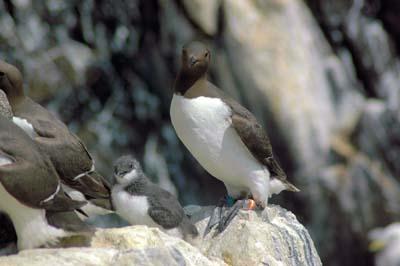
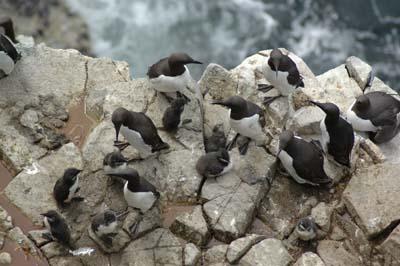
One of Britain's best-known species of seabird is increasingly attacking and killing unattended chicks from neighbouring nests due to food shortages. Researchers at the University of Leeds and the Centre for Ecology & Hydrology observed a dramatic increase in the number of adult guillemots deliberately attacking chicks of the same species in the last year. Hundreds of such attacks occurred, and many were fatal, with chicks being pecked to death or flung from cliff ledges.
These disturbing findings, published online today in the Royal Society journal Biology Letters(1), indicate that social harmony – even in long-established colonies – can break down when conditions get tough, for example if starvation looms. The study highlights a previously unsuspected parental dilemma: should both leave their chick unattended and spend more time feeding, or should one of them remain to protect the chick from attacks from neighbouring birds even if it gets less food?
"The attacks were brutal and usually involved more than one adult as chicks fled from the initial attacking neighbour" says lead author Kate Ashbrook, of Leeds' Faculty of Biological Sciences. "More than two thirds of all documented chick deaths in the sample area were caused by attacks from neighbouring parents. Yet this particular colony has been monitored for almost thirty years, and in that time chick attacks have been very rare occurrences."
Common guillemots (Uria aalge) are attentive parents and rear only one chick during the breeding season, which runs from April to July. Because chicks are vulnerable to attacks from predatory gulls, parents rarely leave them unattended, taking it in turns to find food. However, a decline in prey in recent years has led to both parents being forced to search for food at the same time. Researchers witnessed almost half of all chicks unattended at some point during the day.
Surrounded by neighbours and open to the elements, guillemot colonies are a risky place to raise a chick. Although aggression between adults is common - breeding pairs often are in physical contact and ledges can be densely packed with up to thirty breeding pairs in one square metre – aggression toward chicks is unusual.
The research focused on a large established colony of guillemots that inhabit the Isle of May in Scotland. Co-author Professor Sarah Wanless from the Centre for Ecology & Hydrology has been monitoring this colony since 1981. She comments: "This research highlights how fragile the social fabric of a seabird colony is. Having a stressed, hungry neighbour isn't good news if you're an unattended guillemot chick."
Source: University of Leeds
Other sources
- Neighbors From Hell: Infanticide Rife In Guillemot Colonyfrom Science DailyThu, 18 Sep 2008, 12:49:41 UTC
- Food Shortages Drive Birds to Murder Chicksfrom Live ScienceWed, 17 Sep 2008, 19:21:16 UTC
- Neighbors from hell: Infanticide rife in guillemot colonyfrom Biology News NetWed, 17 Sep 2008, 14:28:18 UTC
- Seabird chicks 'killed over food'from BBC News: Science & NatureWed, 17 Sep 2008, 11:21:29 UTC
- Neighbors from hell: Infanticide rife in guillemot colonyfrom PhysorgWed, 17 Sep 2008, 8:42:49 UTC
- Neighbors From Hell: Infanticide Rife In Guillemot Colonyfrom Science DailyWed, 17 Sep 2008, 2:21:04 UTC