


Black-footed ferrets sired by males that died 8 years ago
Related images
(click to enlarge)
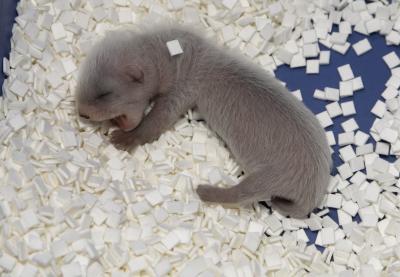
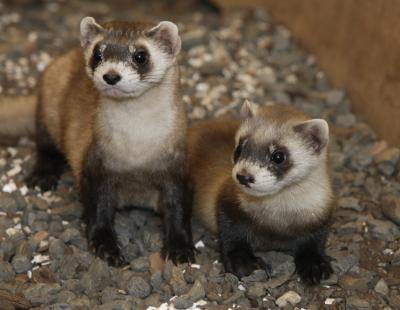
Two black-footed ferrets at the Smithsonian's National Zoo have each given birth to a kit that was sired by males who died in 1999 and 2000. These endangered ferrets—part of a multi-institutional breeding and reintroduction program—were artificially inseminated in May with frozen semen from the two deceased males, each giving birth to a kit on June 20 and 21 respectively. The sperm samples were collected and frozen in 1997 and 1998. Successful inseminations with frozen semen are extremely rare—until now only three black-footed ferret kits have been born from this method. The black-footed ferret is one of the most endangered animals in the world. Once inhabiting the grasslands of the western Great Plains, the black-footed ferret population declined with the loss of the North American prairie ecosystem. Prairie dogs are the ferret's primary prey, and only 2 percent of the original prairie dog habitat remains today. A recent outbreak of sylvatic plague (also known as bubonic plague) in a prairie dog population in South Dakota also threatens to decimate ferret populations there.
For more than 10 years, the semen was stored in the Zoo's Black-Footed Ferret Genome Resource Bank, a repository of frozen semen from the most valuable males. In species that have short life spans like the black-footed ferret, the use of cryopreserved, or frozen, sperm extends an individual's reproductive life. The bank's contents help maintain and even enhance genetic diversity by infusing new genes into the population. A genetically healthy and diverse population has a greater chance of survival in the wild. The bank also serves as insurance against catastrophes in the wild populations, such as a disease outbreak.
The National Zoo has played a critical role in black-footed ferret recovery since 1981 when a small population of the species, previously thought to be extinct, was discovered in Wyoming. The 18 remaining ferrets were removed from the wild to establish a captive breeding and recovery program in Wyoming. The National Zoo's Conservation and Research Center in Front Royal, Va. was the first institution outside of Wyoming to breed the species. Scientists at the National Zoo also developed the first successful artificial insemination technique for the species that deposited sperm directly into the uterus.
The National Zoo's black-footed ferret program works closely with U.S. Fish and Wildlife Service and the Black-Footed Ferret Species Survival Plan to breed and subsequently reintroduce animals into protected areas in South Dakota, Wyoming, Montana, Mexico, Colorado, Utah and Arizona. From 1989 through 2007, more than 500 black-footed ferrets were born at the National Zoo's Conservation and Research Center in Front Royal, Va. with more than 380 born after natural breeding, and more than 130 kits produced after artificial insemination with fresh semen. Following reintroduction, the population has grown from 18 to more than 700 ferrets living in the wild today.
Source: Smithsonian
Other sources
- Black-footed Ferrets Sired By Dead Males Via Frozen Spermfrom Science DailyWed, 3 Sep 2008, 18:07:24 UTC
- Black-footed ferrets sired by males that died 8 years agofrom Biology News NetWed, 3 Sep 2008, 17:56:07 UTC
- Frozen semen helps save endangered speciesfrom UPIWed, 3 Sep 2008, 13:35:08 UTC
- Dead For Years, Ferrets Finally Become Fathersfrom Live ScienceTue, 2 Sep 2008, 18:35:03 UTC
- Black-footed ferrets sired by males that died 8 years agofrom Biology News NetTue, 2 Sep 2008, 16:49:41 UTC
- Black-footed ferrets sired by males that died 8 years agofrom PhysorgTue, 2 Sep 2008, 16:28:10 UTC
- Black-footed Ferrets Sired By Males That Died 8 Years Agofrom Science DailyTue, 2 Sep 2008, 14:21:09 UTC
- Plague threatens prairie dogs, endangered ferretsfrom PhysorgSun, 31 Aug 2008, 8:35:04 UTC
- Plague threatens prairie dogs, endangered ferretsfrom AP ScienceSat, 30 Aug 2008, 19:49:05 UTC