


Researchers study facial structures, brain abnormalities to reveal formula for detection of autism
Related images
(click to enlarge)
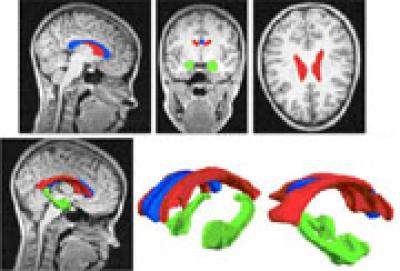
Recently, Harvard researchers reported that children with autism have a wide range of genetic defects, making it nearly impossible to develop a simple genetic test to identify the disorder. Now, University of Missouri researchers are studying 3-D imaging to reveal correlations in the facial features and brain structures of children with autism spectrum disorder (ASD), which will enable them to develop a formula for earlier detection of the disorder. The researchers anticipate their work also will reveal genetic clues that can direct additional research. Autism is a brain disorder characterized by a complex of social, communication and behavioral difficulties. "When you compare the faces and head shapes of children with specific types of autism to other children, it is obvious there are variations. Currently, autism diagnosis is purely behavior based and doctors use tape measurements to check for facial and brain dissimilarities. We are developing a quantitative method that will accurately measure these differences and allow for earlier, more precise detection of specific types of the disorder," said Ye Duan, assistant computer science professor in the MU College of Engineering. "Once we have created a formula, we can pre-screen children by performing a quick, non-invasive scan of each child's face and brain to check for abnormalities. Early detection is crucial in treating children and preparing families."
The U.S. Department of Defense awarded Duan, in collaboration with researchers at the MU Thompson Center for Autism and Neurodevelopmental Disorders, a $110,000 grant to create a facial imaging system that will make identical measurements of the faces of children with ASD. Additionally, the NARSAD Foundation, the world's leading charity dedicated to mental health research, awarded Duan the prestigious Young Investigator Award and $60,000 to fund 3-D imaging of various segments of the brain in children with ASD. The projects also are supported by a $100,000 contribution from other MU sources and $30,000 in Research Scholar Funds.
"Instead of looking at brain structures slice-by-slice in an MRI (magnetic resonance image), we developed tools to create 3-D representations of the structures in order to visualize and make comparisons," said Kevin Karsch, a research assistant in Duan's computer graphics lab, MU senior and Goldwater Scholar. "Using the 3-D representations, we are comparing the brain structures of autistic children to those of non-autistic children; no one has ever done that."
Duan's facial and brain imaging work will focus on two ASD subgroups hypothetically identified by Judith Miles, the William and Nancy Thompson Endowed Chair in Child Health at the Thompson Center. She has observed and distinguished children with a tendency toward more physical and brain abnormalities and smaller heads as having complex autism. Only about 20 percent of affected children fit this subset. The other 80 percent are classified as having essential autism. Miles also has identified physical similarities in facial structure and increased cranium size among those in the essential group and has speculated that the traits may be related to brain abnormalities.
To address the pressing questions about brain development and function in autism, a dozen University of Missouri researchers from a variety of disciplines formed The Autism Neuroscience Research Group (ANRG).
"Our research group is exploiting a tremendous overlap of knowledge from many disciplines. Ye's work will be a pivotal part of ANRG's grand scheme," Miles said. "To solve these problems, it takes an entire community of specialists working together."
Source: University of Missouri-Columbia
Other sources
- Can Facial Structures, Brain Abnormalities Reveal Formula For Detection Of Autism?from Science DailyWed, 20 Aug 2008, 4:21:44 UTC
- Researchers Study Facial Structures, Brain Abnormalities to Reveal Formula for Earlier Detection of Autismfrom Science BlogMon, 18 Aug 2008, 21:49:12 UTC
- Researchers Study Facial Structures, Brain Abnormalities to Reveal Formula for Earlier Detection of Autismfrom PhysorgMon, 18 Aug 2008, 18:35:15 UTC