


OSU students build and launch a sensor into space
Related images
(click to enlarge)
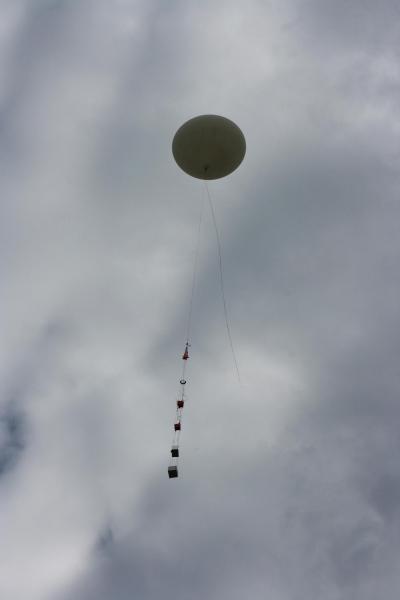
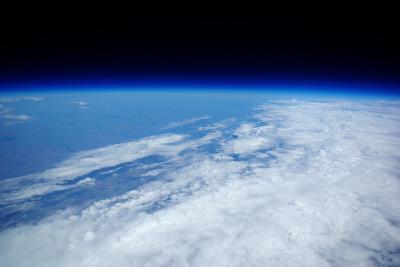

Students from OSU's Radiation Physics Laboratory built and successfully launched a cosmic radiation detector this summer that reached the edge of outer space. Carried by a helium-filled balloon 12 inches in diameter, the detector flew for more than two hours and reached 104,000 feet in altitude. The device recorded radiation levels at the varying altitudes – information that will be used by NASA to develop instrumentation for space flight. "This is really amazing," said Carl Johnson, a physics graduate student who designed and constructed the device. "Our detector actually flew to the edge of outer space and then back to ground, and the whole time it worked perfectly."
In addition to the radiation sensor, the balloon carried a high-resolution camera, sensors for temperature, pressure and humidity, and a GPS module to determine altitude and geographic position. The balloon and instrumentation launched from the Stillwater campus and landed about 10 miles away in Perry. OSU engineering graduate and undergraduate students Joe Conner, Xander Buck and Ryan Paul conducted the launch.
Funded through a NASA EPSCoR grant, this project was overseen by Drs. Eric Benton and Eduardo Yuihara of the OSU physics department and Dr. Andy Arena of OSU department of mechanical and aerospace engineering. Art Lucas of Lucas Newman Science and Technologies also assisted on the design and development of the radiation detector.
Benton said the purpose of the grant is two-fold.
"The purpose of the grant is not only to develop instrumentation for use in space flight but also to promote student interest in science and engineering through experiments with high-altitude balloons," he said. "The best part about the project is that the detector was built from everyday materials and launched into near space from right here in our own backyard. This proves you can accomplish really amazing things with simple materials."
The detector serves as a prototype for radiation detectors that will be included in the Near Space Standard Science Platform, a program used by science students at high schools and colleges around the country conducting research on high-altitude balloons.
Source: Oklahoma State University
Other sources
- Students Build And Launch A Sensor Into Spacefrom Science DailyTue, 12 Aug 2008, 6:28:16 UTC
- OSU students build and launch a sensor into spacefrom PhysorgMon, 11 Aug 2008, 15:14:20 UTC