


Computer simulates thermal stress
Related images
(click to enlarge)
This press release is also available in German. A new simulation method has made it possible to predict in record time when and where heavily stressed engine components are likely to fail. Car manufacturers can thereby significantly reduce the time for developing new engine components.
Exhaust fumes come hissing out of car engines at up to 1050 degrees Celsius – and that's pretty hot! It exposes the engine components to tremendous stress, for they expand heavily in the heat. On frosty days, by contrast, the material contracts. There can be no doubt about it: In the long run, such temperature fluctuations put the material under enormous pressure. The manufacturers therefore test particularly stressed components on a test rig while the vehicle is still under development. However, these investigations cost time and money. Component prototypes have to be built and modified in a time-consuming trial-and-error process until the manufacturer has finally produced a reliable component with no weak points. These investigations have to be repeated for each new material. For certain car manufacturers and suppliers, however, time-consuming component tests are now a thing of the past. A new simulation method developed at the Fraunhofer Institute for Mechanics of Materials IWM in Freiburg enables companies to significantly reduce the time taken to develop exhaust manifolds. Exhaust manifolds collect the hot exhaust fumes from the engine and pass them on to the catalytic converter. They are exposed to particularly high temperatures and therefore under very great stress.
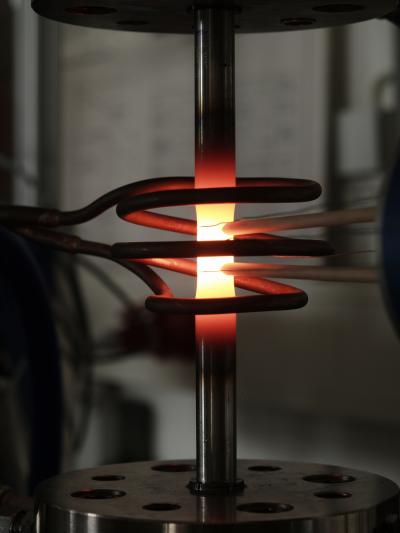
The new simulation method enables the researchers to work out the places in which a component will wear out and fail after a certain number of heating and cooling cycles. Thanks to this, the manufacturer can optimize the shape of the workpiece on the computer and greatly reduce the number of real test runs. The Freiburg scientists take a very close look at the material. Starting by testing the material in the laboratory, they heat, squeeze and pull the metal, repeatedly checking under the microscope when and where tiny cracks begin to form. The researchers then feed these insights into their simulation software. From now on, car manufacturers can use it to calculate how the material will behave and when it will fail, for each new component shape. "It goes without saying that our simulation models can also be applied to all kinds of materials and used in other sectors of industry," says IWM project manager Dr. Thomas Seifert. At present, Seifert and his colleagues are engaged in a joint project with RWE Power and Thyssen-Krupp to investigate heat-resistant nickel alloys for a new generation of power stations. These will be built to operate at particularly high temperatures and achieve a higher degree of efficiency than today's facilities.
Source: Fraunhofer-Gesellschaft
Other sources
- Computer Simulates Thermal Stressfrom Science DailyMon, 11 Aug 2008, 14:21:10 UTC