


Remedial instruction rewires dyslexic brains, provides lasting results, study shows
Related images
(click to enlarge)
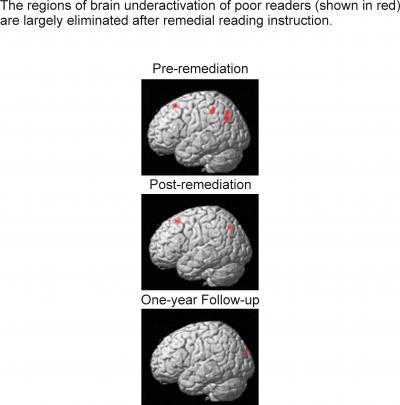
A new Carnegie Mellon University brain imaging study of dyslexic students and other poor readers shows that the brain can permanently rewire itself and overcome reading deficits, if students are given 100 hours of intensive remedial instruction. The study, published in the August issue of the journal Neuropsychologia, shows that the remedial instruction resulted in an increase in brain activity in several cortical regions associated with reading, and that neural gains became further solidified during the year following instruction.
"This study demonstrates how remedial instruction can use the plasticity of the human brain to gain an educational improvement," said neuroscientist Marcel Just, director of Carnegie Mellon's Center for Cognitive Brain Imaging (CCBI) and senior author of the study. "Focused instruction can help underperforming brain areas to increase their proficiency."
Using functional magnetic resonance imaging (fMRI), scientists investigated the changes in a number of cortical regions located in the parietotemporal area, which is responsible for decoding the sounds of written language and assembling them into words and phrases that make up a sentence.
CCBI research fellows Ann Meyler and Tim Keller measured brain activity patterns by examining blood flow to all of the different parts of the brain while children were reading. Those measurements showed that prior to the remediation, the parietotemporal areas were significantly less activated among the poor readers than in the control group.
The new findings showed that many of the poor readers' brain areas activated at near-normal levels immediately after remediation, with only a few areas still underactive. However, at the one year follow-up scan, the activation differences between good and poor readers had nearly vanished, suggesting that the neural gains were strengthened over time, probably just due to engagement in reading activities.
These findings that point to the parietotemporal region's role in reading contradict a common perception that dyslexia is primarily caused by difficulties in the visual perception of letters, leading to confusions between letters like "p" and "d."
Visual difficulties are only at fault in about 10 percent of dyslexia cases. The most common cause, accounting for more than 70 percent of dyslexia, is a difficulty in relating the visual form of a letter to its sound, which is not a straightforward process in the English language. The same parietotemporal areas of the brain that showed increased activity following instruction are centrally involved in this sound-based processing.
The poor readers, 25 fifth-graders from Pittsburgh and its surrounding communities, worked in groups of three for an hour a day with a teacher specialized in administering a remedial reading program. The training included both word decoding exercises in which students were asked to recognize the word in its written form and tasks in using reading comprehension strategies.
This brain imaging study was also the first in which children were tested on their understanding of sentences, not just on their recognition of single words. The sentences were relatively straightforward ones, which the children judged as being sensible or nonsense, such as "The girl closed the gate" and "The man fed the dress." The children's accurate sensibility judgments ensured that they were actually processing the meaning of the sentences, and not just recognizing the individual words.
The research's implications may reach far beyond improving literacy skills. Just noted that the brain's capacity to adapt as the result of targeted instruction has the potential to influence the remedial learning process in other subject areas, as well.
"Any kind of education is a matter of training the brain. When poor readers are learning to read, a particular brain area is not performing as well as it might, and remedial instruction helps to shape that area up," he said. "This finding shows that poor readers can be helped to develop buff brains. A similar approach should apply to other skills."
Additionally, the concrete evidence of improvement demonstrated in this study may be valuable in evaluating the effectiveness of a teaching approach or curriculum, or could even be used to shape education policy. "We are at the beginning of a new era of neuro-education," Just said.
Source: Carnegie Mellon University
Other sources
- Remedial Instruction Rewires Dyslexic Brains, Provides Lasting Results, Study Showsfrom Science DailyTue, 5 Aug 2008, 17:35:35 UTC
- Remedial instruction rewires dyslexic brains, provides lasting results, study showsfrom PhysorgTue, 5 Aug 2008, 16:07:24 UTC