


Negative perception of blacks rises with more news watching, studies say
Related images
(click to enlarge)
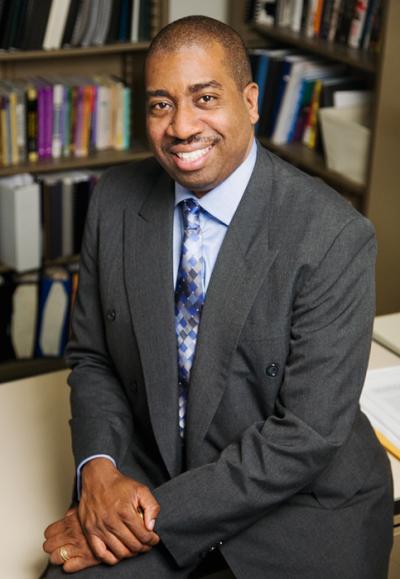
Watching the news should make you more informed, but it also may be making you more likely to stereotype, says a University of Illinois researcher. In a pair of recently published studies, communication professor Travis Dixon found that the more people watched either local or network news, the more likely they were to draw on negative stereotypes about blacks.
Significantly, the effect was independent of viewers' existing racial attitudes, Dixon said. "We've shown that just watching the news – just news consumption alone – has an impact on one's stereotypical conceptions," he said.
In other words, even among those who may think of themselves as largely prejudice-free, those who watch more local or network news are prone to more often see blacks as intimidating, violent or poor, Dixon said.
The studies were published in successive March and June issues of the Journal of Communication. Each was based on data collected in a telephone survey of 506 Los Angeles County residents conducted from November 2002 through January 2003.
In related research, Dixon also is working on studies about stereotyping in the news coverage of Hurricane Katrina and of terrorism.
The study on local news, published in the March issue, built on prior research in several cities – Chicago, Philadelphia and Los Angeles among them – showing local TV news, particularly crime news, as almost always "racialized" in its portrayal of blacks and often other groups, Dixon said. One of the Los Angeles studies, conducted in the mid- to late 1990s, was led by Dixon, and analyzed the news content of individual stations.
In all of the analyses, Dixon said, blacks are overrepresented as perpetrators, whites are overrepresented as victims, and black-on-white crime is overrepresented relative to crime within racial groups. The overrepresentation is relative to police department crime statistics, not population.
"All of these things are inconsistent with what's really happening out there in the quote-unquote real world," Dixon said. "Some news reporters will say they're holding up this mirror (to the real world), but it's a distorted mirror."
Dixon, therefore, said he was not surprised by his findings that those in Los Angeles who watched more local news were more likely to draw on negative stereotypes about blacks. He even found that those who watched the stations that most overrepresented blacks as perpetrators, based on his earlier analysis, were more likely to use or believe those stereotypes.
(Dixon noted that though his analysis of local news content was a decade old, he had seen little evidence of significant change in the way those stations cover the news.)
Dixon is careful not to label either reporters or news consumers as inherently or overtly prejudiced or racist. Instead, he talks about how stereotypes get repeated and therefore reinforced in the mind, a process called "chronic activation." Those stereotypes then come more-readily to mind, consciously or unconsciously, when seeing or interacting with a member of that group, a process called "chronic accessibility."
Through much local television news, "we keep seeing these black perpetrators all the time, so that becomes more accessible and not other conceptions," Dixon said. As a result, any black male is more likely to be seen as potentially violent or a criminal, he said.
What did surprise Dixon, however, was seeing that network news broadcasts, not heavy on crime coverage, had a similar effect on viewers and their tendency to "access" stereotypes. The findings, which he found "disconcerting," contradicted his assumption that those who stayed well-informed through network news would be less prejudiced and hold fewer stereotypes of blacks.
In trying to explain the connection, he believes part of it may be in the way network news often "frames" an issue or topic, such as poverty or welfare, by finding individuals to focus on.
In doing so, they often fall back on stereotypes, he said. "Network news is more subtle, but it's still there."
In his survey, Dixon collected information on a number of factors that could influence stereotypical beliefs other than news-watching – such as gender, age, race, education, political ideology, income, racism, overall television exposure, newspaper exposure, neighborhood diversity and the community's crime rate.
His conclusions about the effect of news-watching came after taking all those factors into account through statistical analysis. "We found that more than a quarter of stereotypical beliefs can be explained just by how much news you watch," he said. If one assumes that respondents may suppress their honest feelings, given that the subject involves race, then the effect could be assumed to be even larger, he said.
Researchers often are careful to note that survey results showing strong associations between two factors – in this case, news-watching and stereotypical belief – do not necessarily mean that one causes the other. Dixon suggests that there may be a causal connection here, however, because his survey work builds on previous experiment-based research with college students, in which different groups were tested after watching different versions of news broadcasts.
The prior research "makes us more confident that what's happening here is causal and not just correlational," Dixon said.
"News viewers need to be empowered to know that media effects are real and that they need to be more conscious of the potential effects," Dixon said. "The fact is we still largely live in a segregated society, so our perceptions of other groups largely come through the media," he said.
"Viewers need to take a little bit more of an active role in demanding better coverage and turning off the tube when it's not good."
Source: University of Illinois at Urbana-Champaign
Other sources
- News can affect stereotyping, study saysfrom UPIFri, 18 Jul 2008, 0:21:07 UTC
- Negative perception of blacks rises with more news watching, studies sayfrom PhysorgThu, 17 Jul 2008, 16:56:10 UTC