


Queen's marine biologist investigates aliens beneath the waves
Related images
(click to enlarge)
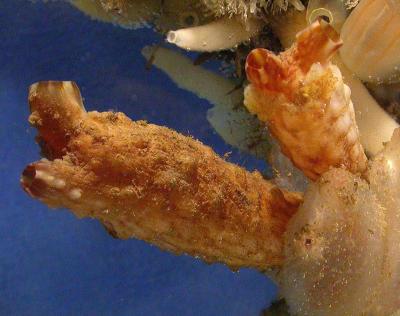

Queen's University Belfast is appealing for help from the public in looking at ways to detect and stop the spread of marine aliens. Activities such as aquaculture, shipping and recreational boating have led to an army of marine alien species hitchhiking around the globe. Now Queen's is attempting to find out exactly where and how non-native species get a foothold in a new area. To do this it is asking for help from the public to record what they have seen.
Part of the Marine Aliens consortium, co-ordinated by the Scottish Association for Marine Science, the project will use the information gathered to look at how invasions can be slowed or preferably prevented. It is very difficult to eradicate an organism once it has become established in a new area.
Professor Christine Maggs, from the School of Biological Sciences at Queen's, said:
"While exotic plants and animals like rhododendrons and grey squirrels are obvious in the British Isles, beneath the waves a hidden invasion of non-native species is taking place around our shores.
"Many marine aliens have left their natural enemies behind and may compete with native species with potentially disastrous consequences for aquaculture, tourism and other marine activities.
"But we can all do our bit for biosecurity - anyone who has a boat or who visits the shore can help by telling scientists what they have seen."
A guide on the Marine Aliens website will help the public identify some of the non-native species which are least wanted, including the Japanese seaweed Sargassum, which has become extremely common in Strangford Lough, the Chinese mitten crab, already found in Ireland, and two species that have not arrived here yet, the Japanese skeleton shrimp and a colonial sea squirt. The site is at www.marlin.ac.uk/marine_aliens
Records of marine life should include as a minimum what was seen, and where and when it was seen. They can be made online at www.marlin.ac.uk/rml and sightings in Ireland can also be reported through the invasive species Ireland website www.invasivespeciesireland.com
Source: Queen's University Belfast
Other sources
- Marine Biologists Investigate Aliens Beneath The Wavesfrom Science DailyThu, 19 Jun 2008, 0:28:10 UTC
- Queen's marine biologist investigates aliens beneath the wavesfrom Biology News NetMon, 16 Jun 2008, 22:49:06 UTC
- Queen's marine biologist investigates aliens beneath the wavesfrom PhysorgMon, 16 Jun 2008, 15:42:11 UTC