


A trio of super-Earths
Related images
(click to enlarge)
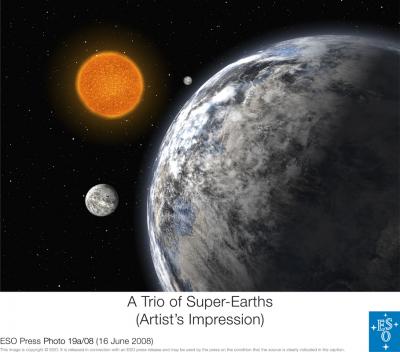
Today, at an international conference, a team of European astronomers announced a remarkable breakthrough in the field of extra-solar planets. Using the HARPS instrument at the ESO La Silla Observatory, they have found a triple system of super-Earths around the star HD 40307. Looking at their entire sample studied with HARPS, the astronomers count a total of 45 candidate planets with a mass below 30 Earth masses and an orbital period shorter than 50 days. This implies that one solar-like star out of three harbours such planets. "Does every single star harbour planets and, if yes, how many?" wonders planet hunter Michel Mayor from Geneva Observatory. "We may not yet know the answer but we are making huge progress towards it."
Since the discovery in 1995 of a planet around the star 51 Pegasi by Mayor and Didier Queloz, more than 270 exoplanets have been found, mostly around solar-like stars. Most of these planets are giants, such as Jupiter or Saturn, and current statistics show that about 1 out of 14 stars harbours this kind of planet.
"With the advent of much more precise instruments such as the HARPS spectrograph on ESO's 3.6-m telescope at La Silla, we can now discover smaller planets, with masses between 2 and 10 times the Earth's mass," says Stéphane Udry, one of Mayor's colleagues. Such planets are called super-Earths, as they are more massive than the Earth but less massive than Uranus and Neptune (about 15 Earth masses).
The group of astronomers have now discovered a system of three super-Earths around a rather normal star, which is slightly less massive than our Sun, and is located 42 light-years away towards the southern Doradus and Pictor constellations.
"We have made very precise measurements of the velocity of the star HD 40307 over the last five years, which clearly reveal the presence of three planets," says Mayor.
The planets, having 4.2, 6.7, and 9.4 times the mass of the Earth, orbit the star with periods of 4.3, 9.6, and 20.4 days, respectively.
"The perturbations induced by the planets are really tiny - the mass of the smallest planets is one hundred thousand times smaller than that of the star - and only the high sensitivity of HARPS made it possible to detect them," says co-author François Bouchy, from the Institut d'Astrophysique de Paris, France.
Indeed, each planet induces a motion of the star of only a few metres per second.
At the same conference, the team of astronomers announced the discovery of two other planetary systems, also with the HARPS spectrograph. In one, a super-Earth (7.5 Earth masses) orbits the star HD 181433 in 9.5 days. This star also hosts a Jupiter-like planet with a period close to 3 years. The second system contains a 22 Earth-mass planet having a period of 4 days and a Saturn-like planet with a 3-year period as well.
"Clearly these planets are only the tip of the iceberg," says Mayor. "The analysis of all the stars studied with HARPS shows that about one third of all solar-like stars have either super-Earth or Neptune-like planets with orbital periods shorter than 50 days."
A planet in a tight, short-period orbit is indeed easier to find than one in a wide, long-period orbit.
"It is most probable that there are many other planets present: not only super-Earth and Neptune-like planets with longer periods, but also Earth-like planets that we cannot detect yet. Add to it the Jupiter-like planets already known, and you may well arrive at the conclusion that planets are ubiquitous," concludes Udry.
Source: ESO
Other sources
- More low-mass exoplanets are discoveredfrom UPIThu, 19 Jun 2008, 14:21:14 UTC
- Astronomers Discover Three New Planetsfrom CBSNews - ScienceTue, 17 Jun 2008, 23:35:20 UTC
- One in Three Stars May Have "Super"-Earths [News]from Scientific AmericanTue, 17 Jun 2008, 22:49:17 UTC
- Three "Super-Earths" Found Orbiting Sun-Like Starfrom National GeographicTue, 17 Jun 2008, 14:35:07 UTC
- Hot news: Barren star has super-Earth tripletsfrom AP ScienceMon, 16 Jun 2008, 22:07:09 UTC
- Trio of 'super-Earths' discoveredfrom BBC News: Science & NatureMon, 16 Jun 2008, 16:35:03 UTC
- A trio of super-Earthsfrom PhysorgMon, 16 Jun 2008, 15:42:14 UTC
- Trio of 'super-Earths' discovered orbiting one starfrom CBC: Technology & ScienceMon, 16 Jun 2008, 15:42:08 UTC
- Three Super-Earths Found Orbiting One Starfrom Space.comMon, 16 Jun 2008, 14:15:05 UTC
- Trio Of Super-Earths: Harvest Of Low-mass Exoplanets Discovered With HARPSfrom Science DailyMon, 16 Jun 2008, 13:28:14 UTC
- Astronomers find batch of "super-Earths"from Reuters:ScienceMon, 16 Jun 2008, 12:00:15 UTC