


Possible new approach to purifying drinking water
Related images
(click to enlarge)
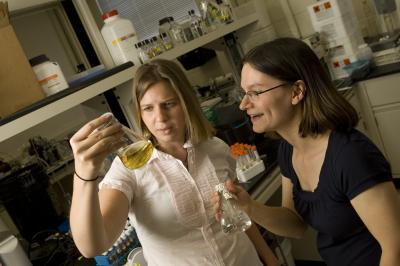
A genetic tool used by medical researchers may also be used in a novel approach to remove harmful microbes and viruses from drinking water. In a series of proof-of-concept experiments, Duke University engineers demonstrated that short strands of genetic material could successfully target a matching portion of a gene in a common fungus found in water and make it stop working. If this new approach can be perfected, the researchers believe that it could serve as the basis for a device to help solve the problem of safe drinking water in Third World countries without water treatment facilities.
The relatively new technology, known as RNA interference (RNAi), makes use of short snippets of genetic material that match -- like a lock and key -- a corresponding segment of a gene in the target. When these snippets enter a cell and attach to the corresponding segment, they can inhibit or block the action of the target gene. This approach is increasingly being used as a tool in biomedical research, but has not previously been applied to environmental issues.
“Pathogens, whether bacterial or viral, represent one of the major threats to drinking water in developed and undeveloped countries,” said Sara Morey, a Ph.D. candidate in the lab of Claudia Gunsch, assistant professor of civil engineering at Duke’s Pratt School of Engineering. “Our data showed that we could silence the action of a specific gene in a fungus in water, leading us to believe that RNAi shows promise as a gene-silencing tool for controlling the proliferation of waterborne bacteria and viruses.”
Morey presented the results of her experiments June 3, 2008, during the annual meeting of the American Society of Microbiology in Boston.
In addition to helping solve drinking water issues in underdeveloped countries, this new approach could also address some of the drawbacks associated with treated drinking water in more developed nations, Morey said. Methods currently used to treat water -- chlorine and ultraviolet (UV) light -- can be expensive to operate and the results of the treatment itself can affect the taste and smell of the water.
Although these methods have been employed for years, problems can emerge once the treated water enters the distribution system, where pathogens are also present. For this reason, water is often over-chlorinated at the plant so that it remains in high enough concentrations in the pipes to neutralize pathogens. This explains why people living the closer to a treatment plant will be more likely to taste or smell the chemical than those farthest away from the plant, the researchers said. Additionally, chlorine can react with other organic matter in the system, leading to potentially harmful by-products.
UV light, while also effective in neutralizing pathogens at the plant, has no effect once the water is pumped out of the plant. Gunsch said that many pathogens are developing a resistance to the effects of chlorine and UV light, so newer options are needed.
“We envision creating a system based on RNAi technology that would look from the outside just like the water filters commonly used now,” Gunsch said. “This approach would be especially attractive in less industrialized countries without water treatment systems. This ‘point-of-use’ strategy would allow these countries to make safe water without the expense of water purification infrastructure.”
The first prototypes would likely involve a filter “seeded” with RNAi that would eliminate pathogens as the water passed through it. These filters would likely need to be replaced regularly, Gunsch said, adding that she believes it would theoretically be possible to create a living, or self-replicating system, which would not require replacement.
The researchers are currently conducting additional experiments targeting other regions of the fungus’ genome. For their proof-of-concept experiments, they tested RNAi on a non-essential, yet easy to monitor, gene. They are now testing this approach to silence or block genes essential to the viability of the pathogen.
They are also planning to test this strategy in water that contains a number of different pathogens at the same time, as well as trying to determine the optimal concentration needed in the water to be effective.
Source: Duke University
Other sources
- Possible new approach to purifying drinking waterfrom PhysorgTue, 3 Jun 2008, 15:56:27 UTC
- Possible New Approach To Purifying Drinking Waterfrom Science DailyTue, 3 Jun 2008, 15:14:35 UTC