


A survivor in Greenland: A novel bacterial species is found trapped in 120,000-year-old ice
Related images
(click to enlarge)
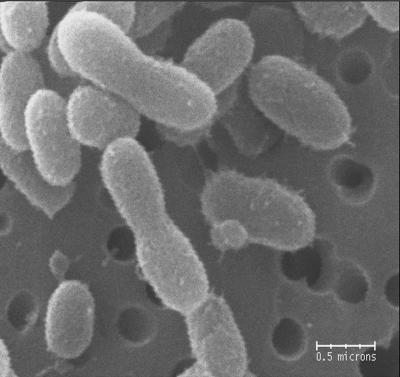
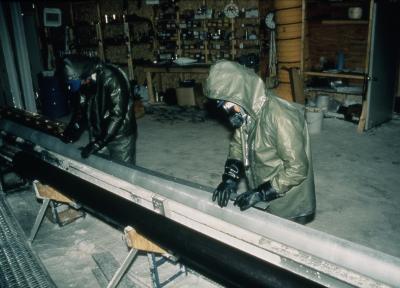
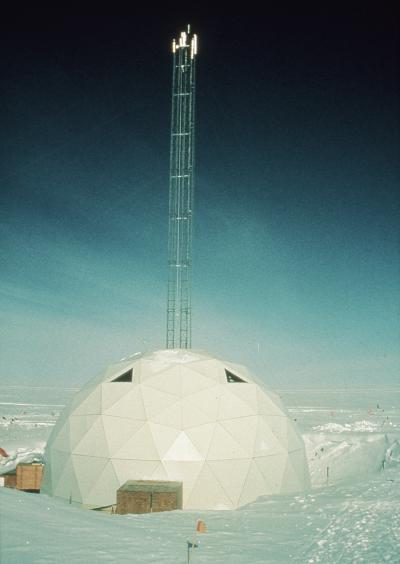
A team of Penn State scientists has discovered a new ultra-small species of bacteria that has survived for more than 120,000 years within the ice of a Greenland glacier at a depth of nearly two miles. The microorganism's ability to persist in this low-temperature, high-pressure, reduced-oxygen, and nutrient-poor habitat makes it particularly useful for studying how life, in general, can survive in a variety of extreme environments on Earth and possibly elsewhere in the solar system. The work will be presented by Jennifer Loveland-Curtze, a senior research associate in the laboratory led by Jean Brenchley, Professor of Biochemistry and Molecular Biology at Penn State, at the 108th American Society for Microbiology General Meeting in Boston, Massachusetts on 3 June 2008 at 10:30 a.m. (Extreme Environments-I, poster N-156). This new species is among the ubiquitous, yet mysterious, ultra-small bacteria, which are so tiny that the cells are able to pass through microbiological filters. In fact, some species have been found living in the ultra-purified water used for dialysis. "Ultra-small cells could be unknown contaminants in media and medical solutions that are thought to have been sterilized using filters," said Loveland-Curtze.
The ultra-small size of the new species could be one explanation for why it was able to survive for so long in the Greenland glacier. Called Chryseobacterium greenlandensis, the species is related genetically to certain bacteria found in fish, marine mud, and the roots of some plants. The organism is one of only about 10 scientifically described new species originating from polar ice and glaciers.
To study the bacterium in the laboratory, the research team, which also includes Senior Research Associate Vanya Miteva, filtered the cells from melted ice and incubated them in the cold in low-nutrient, oxygen-free solutions. The scientists then characterized the genetic, physiological, biochemical, and structural features of the species. The team hopes that its studies of this species, as well as others living in the Greenland glacier, will reveal more about how cells survive and how they may alter their biochemistry and physiology over time. "Microbes comprise up to one-third or more of the Earth's biomass, yet fewer than 8,000 microbes have been described out of the approximately 3,000,000 that are presumed to exist," said Loveland-Curtze. "The description of this one species is a significant step in the overall endeavor to discover, cultivate, and use the special features held by these organisms."
Source: Penn State
Other sources
- Bacteria found in 120,000-year-old icefrom UPIThu, 5 Jun 2008, 21:35:27 UTC
- Bacteria found in 120,000-year-old icefrom UPIThu, 5 Jun 2008, 16:42:37 UTC
- A survivor in Greenland: A novel bacterial species is found trapped in 120,000-year-old icefrom Biology News NetTue, 3 Jun 2008, 23:49:10 UTC
- A Survivor in Greenland: A Novel Bacterial Species is Found Trapped in 120,000-Year-Old Icefrom PhysorgTue, 3 Jun 2008, 15:56:27 UTC
- A Survivor In Greenland: A Novel Bacterial Species Is Found Trapped In 120,000-year-old Icefrom Science DailyTue, 3 Jun 2008, 15:14:34 UTC