


First electrophysical recording of sleep in a wild animal
Related images
(click to enlarge)
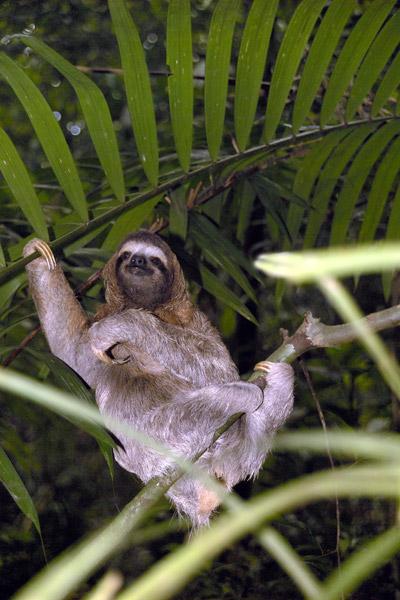
In the first experiment to record the electrophysiology of sleep in a wild animal, three-toed sloths carrying miniature electroencephalogram recorders slept 9.63 hours per day—6 hours less than captive sloths did, reports an international team of researchers working on the Smithsonian Tropical Research Institute’s Barro Colorado Island in Panama. “We are fascinated that some species sleep far longer than others. If we can determine the reasons for variations in sleep patterns, we will gain insight into the function of sleep in mammals, including humans,” said first author Niels Rattenborg, group leader of the Sleep and Flight Group at the Max Planck Institute for Ornithology. “If animals behave differently in captivity (where all previous comparative studies were performed) than they do in the wild, measuring their brain activity in captivity can lead to the wrong conclusions.”
The research team got around this problem by using a technique developed for monitoring brain activity in humans in conjunction with a newly developed miniature recorder for neurophysiological data in order to monitor sleep in the wild.
In addition to two brain activity sensors worn as a cap on their heads, three adult three-toed sloths, Bradypus variegatus, also were fitted with radio-telemetry collars and accelerometers so that their exact locations and movements could be monitored during the next three to five days. The activity of two other sloths was monitored via radio-telemetry collar alone, for approximately seven months using a unique Automated Radio Telemetry System in place on the island.
The placement of sensors on sloths living in treetops demonstrates the feasibility of understanding a complex behavior, such as sleep, in the intricate tropical forest environment. It also will lead to more refined, comparative sleep research.
“The beauty of the automated telemetry system is that it makes a new suite of animal behavior studies possible,” said Martin Wikelski, director of the Max Plank Institute for Ornithology, researcher at Princeton University and research associate at the Smithsonian. “We certainly encourage researchers who would like to monitor animals in the wild to join our ongoing studies or initiate work using the system.”
Source: Smithsonian Tropical Research Institute
Other sources
- Wild Three-Toed Sloths Sleep 6 Hours Less Per Day Than Captive Sloths, First Electrophysical Recording Showsfrom Science DailyWed, 14 May 2008, 12:21:20 UTC
- First electrophysical recording of sleep in a wild animalfrom PhysorgWed, 14 May 2008, 11:35:46 UTC
- Sloth's lazy image 'a myth'from BBC News: Science & NatureTue, 13 May 2008, 23:56:13 UTC