


The Antennae Galaxies move closer
Related images
(click to enlarge)
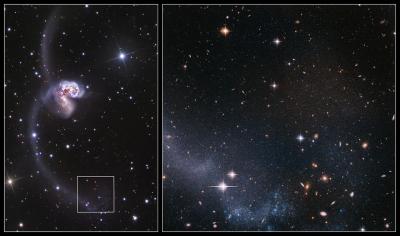
The Antennae Galaxies are among the closest known merging galaxies. The two galaxies, also known as NGC 4038 and NGC 4039, began interacting a few hundred million years ago, creating one of the most impressive sights in the night sky. They are considered by scientists as the archetypal merging galaxy system and are used as a standard against which to validate theories about galaxy evolution. An international group of scientists led by Ivo Saviane from the European Southern Observatory has used Hubble’s Advanced Camera for Surveys and Wide Field Planetary Camera 2 to observe individual stars spawned by the colossal cosmic collision in the Antennae Galaxies. They reached an interesting and surprising conclusion. By measuring the colours and brightnesses of red giant stars in the system, the scientists found that the Antennae Galaxies are much closer than previously thought: 45 million light-years instead of the previous best estimate of 65 million light-years.
The team targeted a region in the relatively quiescent outer regions in the southern tidal tail, away from the active central regions. This tail consists of material thrown from the main galaxies as they collided. The scientists needed to observe regions with older red giant stars to derive an accurate distance. Red giants are known to reach a standard brightness, which can then be used to infer their distance. The method is known as the tip of the red giant branch (TRGB).
The proximity of the Antennae system means it is the best-studied galaxy merger in the sky, with a wealth of observational data to be compared to the predictions of theoretical models. Saviane says: “All aspiring models for galaxy evolution must be able to account for the observed features of the Antennae Galaxies, just as respectable stellar models must be able to match the observed properties of the Sun. Accurate models require the correct merger parameters, and of these, the distance is the most essential”.
The previous canonical distance to the Antennae Galaxy was about 65 million light-years although values as high as 100 million light years have been used. Our Sun is only eight light-minutes away from us, so the Antennae Galaxies may seem rather distant, but if we consider that we already know of galaxies that are more than ten billion light-years away, the two Antennae Galaxies are really our neighbours.
The previous larger distance required astronomers to invoke some quite exceptional physical characteristics to account for the spectacular system: very high star-formation rates, supermassive star clusters, ultraluminous X-ray sources etc. The new smaller distance makes the Antennae Galaxies less extreme in terms of the physics needed to explain the observed phenomena. For instance, with the smaller distance its infrared radiation is now that expected of a “standard” early merging event rather than that of an ultraluminous infrared galaxy. The size of the star clusters formed as a consequence of the Antennae merger now agree with those of clusters created in other mergers instead of being 1.5 times as large.
The Antennae Galaxies are named for the two long tails of stars, gas and dust that resemble the antennae of an insect. These “antennae” are a physical result of the collision between the two galaxies. Studying their properties gives us a preview of what may happen when our Milky Way galaxy collides with the neighbouring Andromeda galaxy in several billion years. Although galaxy mergers today are not common, it is believed that in the past they were an important channel of galaxy evolution. Therefore understanding the physics of galaxy mergers is a very important task for astrophysicists.
The Antennae are located in the constellation of Corvus, the Crow.
Source: ESA/Hubble Information Centre
Other sources
- The Antennae Galaxies move closerfrom Science BlogMon, 12 May 2008, 13:07:07 UTC
- Merging Antennae Galaxies Move Closerfrom Science DailyFri, 9 May 2008, 15:21:08 UTC
- The Antennae Galaxies move closerfrom PhysorgFri, 9 May 2008, 14:35:11 UTC