


When bears steal human food, mom's not to blame
Related images
(click to enlarge)
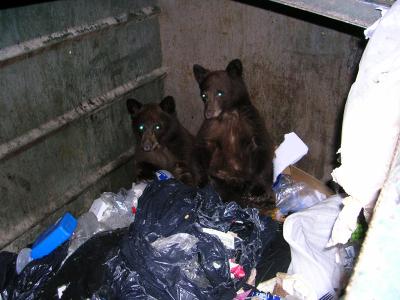
Researchers from the Wildlife Conservation Society (WCS) found that the black bears that become habituated to human food and garbage may not be learning these behaviors exclusively from their mothers, as widely assumed. Bears that steal human food sources are just as likely to form these habits on their own or pick them up from unrelated, “bad influence” bears. The study, which examines the role of genetic relatedness in black bear behavior that leads to conflict with humans, appears in the latest edition of the Journal of Mammalogy.
“Understanding how bears acquire behavior is important in conservation biology and devising strategies to minimize potential human-wildlife conflicts,” says Dr. Jon Beckmann, a co-author of the study. “According to our findings, bears that feed on human food and garbage are not always learning these habits from their mothers.”
Distributed across much of North America, black bears—which average around 300 pounds in weight—become a problematic species for wildlife managers when they become accustomed to human sources of food, and the habit is a hard one to break. Bears that develop these tendencies often remain ‘problem’ bears for human communities, leading to property damage, injuries to people, not to mention costly relocation and sometimes death for bears.
Working in both the Lake Tahoe Basin on the California-Nevada border and California’s Yosemite National Park (where bears breaking into visitors’ cars has become commonplace), the researchers examined genetic and behavioral data for 116 black bears. The bears were classified as either food-conditioned (or hooked on human food) or non-food-conditioned (those bears that forage on natural food sources). The study also focused on nine mother-offspring pairs to test the assumption that mother bears teach their cubs to invade garbage bins or homes.
The verdict: Researchers found little evidence linking food-conditioned behavior with related lineage. The study indicates that bears may seek out human food as a function of social learning that may be independent of close relatives, or as a habit that is acquired in isolation from other bears. Specifically, the study identified the mothers of nine of the bears in the study, of which five (56 percent) did not share the behavioral habits of their mothers.
“These findings can help inform management strategies that would otherwise assume that cubs will always repeat the behaviors of food-conditioned mothers,” says Dr. Jodi Hilty, Director of WCS-North America. “Moving mothers and cubs may have only a limited effect in eliminating human-bear conflicts, which seem to be primarily driven by human food sources that are available to bears.”
Meanwhile on the East Coast, WCS-Adirondacks has been supplying the High Peaks Wilderness Area in upstate New York with bear-proof food canisters for campers to rent at local stores. A recent survey found that 95 percent of campers now use the canisters, and reports of conflicts between bears and campers have declined significantly.
Source: Wildlife Conservation Society
Other sources
- When Bears Steal Human Food, Mom's Not To Blamefrom Science DailyFri, 9 May 2008, 15:21:04 UTC
- When bears steal human food, mom's not to blamefrom PhysorgWed, 7 May 2008, 21:21:15 UTC
- Are some bears just born to be bad?from MSNBC: ScienceTue, 6 May 2008, 21:07:06 UTC
- Hey Yogi! Bears' Picnic Basket Theft Secrets Revealedfrom Live ScienceTue, 6 May 2008, 17:56:17 UTC
- When Bears Steal Human Food, Mom's Not to Blamefrom Newswise - ScinewsTue, 6 May 2008, 17:35:15 UTC