


Biodiversity -- it's in the water
Related images
(click to enlarge)
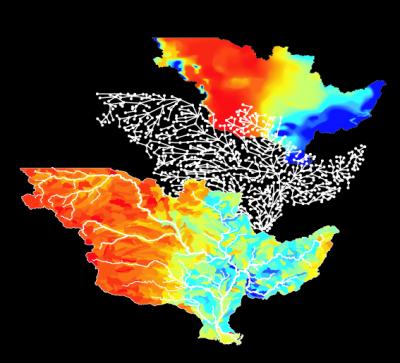
What if hydrology is more important for predicting biodiversity than biology" Research published in the May 8th issue of the journal Nature challenges current thinking about biodiversity and opens up new avenues for predicting how climate change or human activity may affect biodiversity patterns. In the article, an international group of researchers demonstrates that the biodiversity of fish species in a river system can be accurately predicted with a simple method that uses only the geomorphology of the river network and rainfall measurements for the river system.
The 3,225,000 km2 Mississippi-Missouri river basin covers all or part of 31 US states, spanning diverse habitat types and encompassing very different environmental conditions. The one thing linking all these habitats is the river network. Using geomorphological data from the US Geological Survey, the researchers – hydrologists from Princeton University and the EPFL in Lausanne, Switzerland, and biologists from the University of Maryland -- identified 824 sub-basins in the network. In these, the simple presence (or not) of 433 species of fish was established from a database of US freshwater fish populations. Data on the average runoff production –the amount of rainfall that ends up in the river system and not evaporated back into the air – was then used to calculate the habitat capacity of each sub-basin.
With just four parameters, it’s “an almost ridiculously simple model,” explains EPFL professor Andrea Rinaldo. The model results were compared to extensive data on actual fish species distributions. Various different measures of biodiversity were analyzed, and the researchers were surprised to find that the model captured these complex patterns quite accurately. The model is all the more remarkable for what it does not contain – any reference, anywhere, to the biological properties of individual fish species.
It is a formulation that could be applied to any river system, or in fact, any network at all. All that's needed are the geomorphology of the landscape and an estimate of average dispersal behavior and habitat capacity. This model is general enough that it could be used to explore population migrations or epidemics of water-borne diseases in addition to biodiversity patterns. The researchers plan to extend their work to explore the extent to which simple hydrology can act as the determining factor in a wide range of biodiversity patterns.
“These results are a powerful reminder of the overarching importance of water, and the water-defined landscape, in determining patterns of life,” notes Princeton professor Ignacio Rodriguez-Iturbe. It provides a framework that could be used to connect large scale environmental changes to biodiversity. Changes in precipitation patterns, perhaps due to global climate change, could be mapped to changes in habitat capacities in the model, ultimately providing a way to estimate how climate change would alter large-scale patterns of biodiversity. It could also be used for an assessment of the impact of specific, local human activities, such as flow re-routing or damming, on the biodiversity patterns in a river network.
Source: Ecole Polytechnique Fédérale de Lausanne
Other sources
- Biodiversity: It's In The Waterfrom Science DailyWed, 7 May 2008, 18:21:10 UTC