


Dwarf cloud rat rediscovered after 112 years
Related images
(click to enlarge)
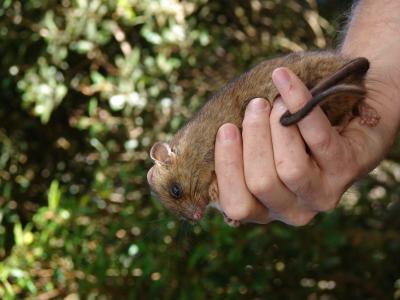

A team of Filipino and American scientists have rediscovered a highly distinctive mammal ¨C a greater dwarf cloud rat ¨C that was last seen 112 years ago. Furthermore, it has never before been discovered in its natural habitat and was thought by some to be extinct. The greater dwarf cloud rat (Carpomys melanurus) has dense, soft reddish-brown fur, a black mask around large dark eyes, small rounded ears, a broad and blunt snout, and a long tail covered with dark hair. An adult weighs about 185 grams.
"This beautiful little animal was seen by biologists only once previously ¨C by a British researcher in 1896 who was given several specimens by local people, so he knew almost nothing about the ecology of the species," said Lawrence Heaney, Curator of Mammals at the Field Museum and Project Leader. "Since then, the species has been a mystery, in part because there is virtually no forest left on Mt. Data, where it was first found."
On 24 April, the research team completed its field work, the first comprehensive survey of the small mammals of Mt. Pulag National Park, according to Samuel Penafiel, the Regional Executive Director for the Philippine Department of Environment and Natural Resources for the Cordillera Administrative Region. Among the results was the capture of the dwarf cloud rat, which is a smaller relative of the giant clouds rats, spectacular animals found only on Luzon Island, but widespread and comparatively well known.
The dwarf cloud rat was captured by Danilo Balete, Project Co-Leader and Research Associate of the Philippine National Museum, in a patch of mature mossy forest (also called cloud forest) high on Mt. Pulag, at about 2,350 meters above sea level. It was in the canopy of a large tree, on a large horizontal branch covered by a thick layer of moss, orchids, and ferns, about 5 meters above ground, Balete said. "We had suspected from its broad, hand-like hind feet that it lived up in big trees, but this is the first evidence to confirm that."
Since this is the first time the dwarf cloud rat has been seen in its natural habitat, the data collected from this specimen "will significantly augment our understanding of how these rodents evolved, what makes them tick, and how we can keep them around," said William Stanley, Collections Manager of Mammals at The Field Museum. "Also, finding this animal again gives us hope for the conservation of one of the most diverse and threatened mammal faunas of the world."
The research team thinks that this species probably lives only high in the big canopy trees in mature mossy forest, at elevations from about 2,200 to 2,700 meters, high in the mountains of the Central Cordillera. "Now that we know where to look for them, it will be possible to learn more," Heaney said.
Much of the mossy forest in Mt. Pulag National Park where the biologists found the dwarf cloud rat was logged during the 1960s, and few large trees remain. The mossy forest has been gradually regenerating, but many local people now have vegetable farms there, and some of the mossy forest has disappeared as a result, according to Park Superintendent Emerita Albas. "Other parts of the park have extensive areas of mossy forest," she said. "But where there are roads into the park, the vegetable farms are expanding. The people deserve to have a place to live and to have their farms, but the mossy forest needs to be protected."
The mossy forest is like a giant sponge when it rains, soaking up the water and releasing it gradually. This produces clean water for irrigation, household use, hydroelectric dams, and industry in the lowlands. The mossy forest gets up to 5 or 6 meters of rain per year, or more.
Most of the species that the team documented on Mt. Pulag live only in the Central Cordillera, and most live only in mossy forests. Other unusual species documented by this research team during this survey are the bushy-tailed cloud rat, a spectacular animal of 1.5 kg with long, flowing black fur that they found to be common in mossy forest at 2,600 to 2,800 meters elevation, as well as three species of small rodents that feed primarily on earthworms. One of these small rodents was originally discovered by the same Field Museum research team and formally described as a new species only in 2006. Mt. Pulag is the only place currently known that has four species of cloud rats known to be present.
The team found that the pest rodents that cause damage around buildings and in the vegetable gardens on Mt. Pulag are not native species. Instead they are species, such as the Norway rat, that were accidentally brought to the Philippines centuries ago. The native species avoid humans, live in the forest, and cause very little if any economic damage. Some, like the dwarf cloud rat, probably are not able to withstand much disturbance of their natural habitat.
Cloud rats are one of the most spectacular cases of adaptive radiation by mammals anywhere in the world, with at least 15 species ranging in size from 2.6 kg to 15 grams, all living only in the Philippines. Cloud rats are a prime example of why biologists refer to the Philippines as "the Galapagos times ten," Heaney said. "The Philippines may have the greatest concentration of unique biological diversity, relative to its size, of any country in the world."
Source: Field Museum
Other sources
- Dwarf cloud rat rediscovered after 112 yearsfrom Biology News NetFri, 2 May 2008, 16:42:04 UTC
- Dwarf Cloud Rat Rediscovered After 112 Yearsfrom Science DailyThu, 1 May 2008, 22:14:13 UTC
- Dwarf cloud rat rediscovered after 112 yearsfrom PhysorgThu, 1 May 2008, 19:35:03 UTC