


Researchers develop method for transmitting medical images via cell phones
Related images
(click to enlarge)
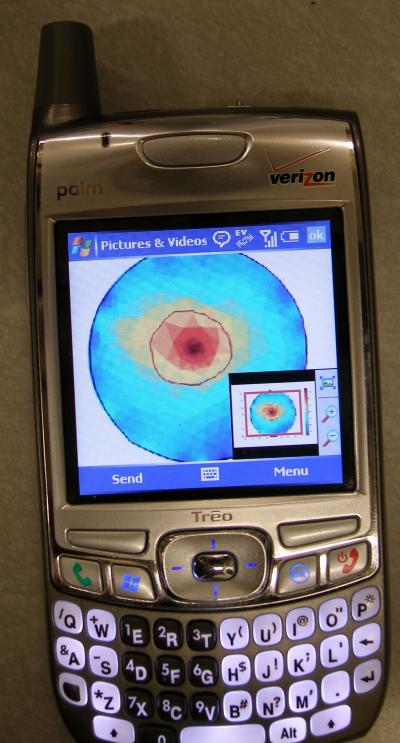
A process to transmit medical images via cellular phones that has been developed by a Hebrew University of Jerusalem researcher has the potential to provide sophisticated radiological diagnoses and treatment to the majority of the world’s population lacking access to such technology. This would include millions in developing nations as well as those in rural areas of developed countries who live considerable distances from modern medical centers. Prof. Boris Rubinsky has demonstrated the feasibility of his new concept that can replace current systems -- which are based on conventional, stand-alone medical imaging devices -- with a new medical imaging system consisting of two independent components connected through cellular phone technology. The concept could be developed with various medical imaging modalities. This new technique is described in the latest online issue of the journal, Public Library of Science ONE (PLoS ONE).
Rubinsky is head of the Research Center for Research in Bioengineering in the Service of Humanity and Society at the Benin School of Computer Science and Engineering at the Hebrew University of Jerusalem and is also a professor of bioengineering and mechanical engineering at the University of California, Berkeley. Working with him on this project were Yair Granot and Antoni Ivorra, both of the Biophysics Graduate Group of the latter institution.
Their invention is jointly patented and owned by Yissum, the Hebrew University’s Technology Transfer Company, and by the University of California, Berkeley. Commercialization efforts will be made by Yissum and by Berkeley's technology transfer organization.
According to the World Health Organization, some three-quarters of the world's population has no access to ultrasounds, X-rays, magnetic resonance images and other medical imaging technology used for a wide range of applications, from detecting tumors to confirming signs of active tuberculosis infections to monitoring the health of developing fetuses during pregnancy.
The conventional medical imaging systems in use today -- self-contained units combining data acquisition hardware with software processing hardware and imaging display -- are expensive devices demanding sensitive handling and maintenance and extensive user training. Only those treatment centers with the required financial and manpower resources are usually able to acquire and utilize them. Even when such equipment does exist in developing countries, it is often not in use because it is too sophisticated or in disrepair or because the health personnel are not trained to use it, said Rubinsky..
"Imaging is considered one of the most important achievements in modern medicine. Diagnosis and treatment of an estimated 20 percent of diseases would benefit from medical imaging, yet this advancement has been out of reach for millions of people in the world because the equipment is too costly to maintain. Our system would make imaging technology inexpensive and accessible for these underserved populations," said Rubinsky.
Under the new technology developed by Rubinsky, an independent data acquisition device (DAD) at a remote patient site that is simple with limited controls and no image display capability would be connected via cellular phone technology with an advanced image reconstruction and hardware control multiserver unit at a central site (which can be anywhere in the world).
The cellular phone technology transmits unprocessed, raw data from the patient site DAD to the cutting- edge central facility that has the sophisticated software and hardware required for image reconstruction. This data is then returned from the central facility to the cellular phone at the DAD site in the form of an image and displayed on its screen. "The DAD can be made with off-the-shelf parts that somebody with basic technical training can operate,” Rubinsky noted.
The fact that the image itself is produced in a centralized location and not on the measurement device has the potential to make technological advances in medical imaging processing continuously available to remote areas of the world, which despite their lack of sophisticated equipment in general often do have cell phone communication. (Indeed, it is estimated that more than 60 percent of all cell phones currently in use in the world are in developing countries.)
Rubinsky stresses the key economic benefits of this new method: By simplifying the apparatus at the patient site, it reduces the cost of medical imaging devices in general. It also removes the need for advanced imaging training of the personnel at the patient site.
The researchers chose electrical impedance tomography (EIT) to demonstrate the feasibility of using cell phones in medical imaging. EIT is based upon the principle that diseased tissue transmits electrical currents differently from healthy tissue. The difference in resistance from electrical currents is translated into an image, which can be transmitted via cell phone technology.
Utilizing commercially available parts, the research team built a simple data acquisition device for the experiment. The device had 32 stainless steel electrodes – half to inject the electrical current and the other half to measure the voltage – connected to a gel-filled container that simulated breast tissue with a tumor.
A total of 225 voltage measurements were taken and uploaded to a cell phone, which was hooked up to the device with a USB cable. The cell phone was then used to dial into a powerful central computer that contained software to process the packet of raw data that was transmitted. An image was then reconstructed and sent back to the cell phone for viewing. The researchers verified that the simulated tumor was clearly visible in the image, demonstrating the proof-of-principle that this system is feasible.
Source: The Hebrew University of Jerusalem
Other sources
- Engineers Harness Cell Phone Technology For Use In Medical Imagingfrom Science DailyWed, 30 Apr 2008, 20:14:05 UTC
- Cell phones may be medical imaging toolsfrom UPIWed, 30 Apr 2008, 18:42:29 UTC