


Compact galaxies in early universe pack a big punch
Related images
(click to enlarge)
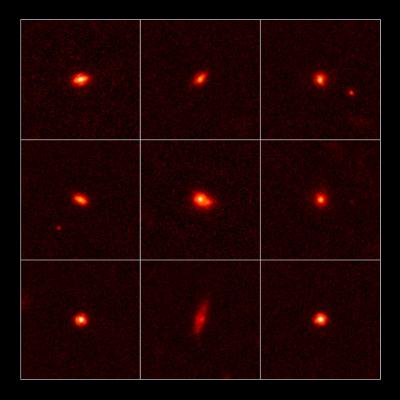
Imagine receiving an announcement touting the birth of a baby 50 centimetres long and weighing 80 kilograms. After reading this puzzling message, you would immediately think the baby’s weight was a misprint. Astronomers looking at galaxies in the Universe’s distant past received a similar perplexing announcement when they found nine young, compact galaxies, each weighing in at 200 billion times the mass of the Sun. The galaxies, each only 5,000 light-years across, are a fraction of the size of today's grownup galaxies but contain approximately the same number of stars. Each galaxy could fit inside the central hub of our Milky Way Galaxy.
Astronomers used the NASA/ESA Hubble Space Telescope and the W.M. Keck Observatory on Mauna Kea, Hawaii, to study the galaxies as they existed 11 billion years ago, when the Universe was less than 3 billion years old.
“Seeing the compact sizes of these galaxies is a puzzle", said Pieter G. van Dokkum of Yale University in New Haven, Connecticut, USA, who led the study. "No massive galaxy at this distance has ever been observed to be so compact. These galaxies would have to change a lot over 11 billion years, growing five times bigger. They could get larger by colliding with other galaxies, but such collisions may not be the complete answer. It is not yet clear how they would build themselves up to become the large galaxies we see today”.
To determine the sizes of the galaxies, the team used the Near Infrared Camera and Multi-Object Spectrometer on Hubble. The Keck observations were carried out with assistance of a powerful laser to correct for image blurring caused by the Earth's atmosphere. Only Hubble, Keck and ESO’s Very Large Telescope are really able to measure the sizes of these galaxies as they are very small and far away.
Van Dokkum and his colleagues studied the galaxies in 2006 with the Gemini South Telescope Near-Infrared Spectrograph, on Cerro Pachon in the Chilean Andes. Those observations provided the galaxies’ distances and showed that the stars are a half a billion to a billion years old. The most massive stars had already exploded as supernovae.
“In the Hubble Deep Field, astronomers found that star-forming galaxies are small”, said Marijn Franx of Leiden University, The Netherlands. “However, these galaxies were also very low in mass. They weigh much less than our Milky Way. Our study, which surveyed a much larger area than in the Hubble Deep Field, surprisingly shows that galaxies with the same weight as our Milky Way were also very small in the past. All galaxies look really different in early times, even massive ones that formed their stars early”.
The ultra-dense galaxies might comprise half of all galaxies of that mass 11 billion years ago, van Dokkum said, forming the building blocks of today’s largest galaxies.
How did these small, crowded galaxies form? One way, suggested van Dokkum, involves the interaction of dark matter and hydrogen gas in the nascent Universe. Dark matter is an invisible form of matter that accounts for most of the Universe’s mass. Shortly after the Big Bang, the Universe contained an uneven landscape of dark matter. Hydrogen gas became trapped in pockets of the invisible material and began spinning rapidly in dark matter’s gravitational whirlpool, forming stars at a furious rate.
Based on the galaxies’ mass, which is derived from their colour, the astronomers estimated that the stars are spinning around their galactic disks at roughly 400 to 500 kilometres per second. Stars in today’s galaxies, by contrast, are travelling at about half that speed because they are larger and rotate more slowly than the compact galaxies.
These galaxies are ideal targets for the Wide Field Camera 3, which is scheduled to be installed aboard Hubble during Servicing Mission 4 in the fall of 2008.
Source: ESA/Hubble Information Centre
Articles on the same topic
- Ultra-dense galaxies found in early universeWed, 30 Apr 2008, 18:58:50 UTC
Other sources
- Tiny Young Galaxies "Full of Stars" Discoveredfrom National GeographicWed, 30 Apr 2008, 22:35:03 UTC
- Compact Galaxies in Early Universe Pack a Big Punchfrom Newswise - ScinewsWed, 30 Apr 2008, 18:52:54 UTC
- Young Galaxies Surprisingly Packed with Starsfrom Space.comWed, 30 Apr 2008, 18:51:35 UTC
- Astronomers Eye Ultra-Young, Bright Galaxy in Early Universefrom NASA Jet Propulsion LaboratoryWed, 30 Apr 2008, 18:49:18 UTC